
Category: Greece mainland

  • Marathopoli: A mellow seaside town and ideal base for exploring southwestern Messenia

    Share

    Marathopoli and Proti island

    An aerial view looking west toward the town of Marathopoli and Proti Island. The photo is from the website for Marathopoli’s Artina Hotel Nuovo, where we stayed two nights while visiting historic sites, towns and attractions on a road trip through the Messenia region of the southwestern Peloponnese .


    Great location: I didn’t know anything about Marathopoli when our travelling companions suggested we use the small seaside town as a base during two days of our road trip in the Messenian region of the Peloponnese last spring. Quite frankly, I didn’t know exactly where it was or what was there, and I doubt I had even heard of the place before they mentioned it.

    What we discovered when we got there, on Day 2 of our trip, was a quiet, laid-back town that was a perfect spot to unwind after busy days of driving, hiking and sightseeing. And, just as our friends had pointed out, it was very conveniently located. All of the major attractions we wanted to see — Methoni Castle, Voidokilia beach, the old castle of Navarino, and the town of Pylos — were less than 40 minutes away. Many more historic sites, beaches and natural attractions we didn’t have time to visit were within reasonable driving distances as well, including The Palace of Nestor; Golden Beach – Mati and Vromomeri beach; and the Valta waterfall,  Neda River, Polylimnio lakes and waterfalls, Gialova wetlands, and more. 


    [adToAppearHere]


    From a tourist perspective, Marathopoli isn’t a particularly remarkable town in and of itself. Although it’s located on the coast, the built-up area of businesses and residences is spread across flat terrain, so it doesn’t boast a naturally picturesque and scenic setting like the more famous Messenian hillside towns of Pylos and Kyparissia. Its streets aren’t as photogenic, since there are no cobblestone lanes lined with rustic old houses and impressive historic buildings to stroll around.

    When we arrived at Marathopoli and passed through the main section of town on the way to our accommodations, we found a compact commercial strip with three supermarkets and several other shops catering to the local residents, a couple of cafes and tavernas, and a number of vacant storefronts.  The business area, which occupies just a couple of short blocks, is fairly basic and nondescript — it hasn’t been fancied up with boutique shops, hipster cafes and trendy wine bars geared to upmarket travellers. From what I recall, it didn’t have any shops selling T-shirts and tacky cheap souvenirs, either. The town seemed unassuming and refreshingly “non-touristy,” at least at the low season time we were there. (It could be a slightly different story during the peak travel months of July and August, though.)


    Marathopoli main street

    A Google Streetview photo of the business area along Marathopoli’s main street


    However, Marathopoli does have an attractive pedestrian zone just off the main drag, where visitors will enjoy going for coffee, drinks or dinner, or to take walks with views of the sea and Proti Island.  One block, which leads from the main street toward the sea, has been pleasantly landscaped with brick and flagstone pavement, benches, planter boxes, and old-style streetlamps. Restaurants, a few shops and a bank occupy the buildings along both sides of the block. The street intersects with a flagstone-paved pedestrian walkway (Πεζόδρομος — pezodromos) that extends along the seafront all the way to the town harbour.  Locals refer to it in English as The Sidewalk, and it is the town’s go-to area for a good selection of fish tavernas, traditional Greek restaurants, coffee shops and bars, many of which have open-air patios along the seafront. We found the pedestrian areas incredibly quiet in daytime and early evening, but humming with people and activity at night, once all of the restaurants had opened.


    a street in Marathopoli

    Visitors will find a bank, shops and restaurants on this block-long pedestrian street which leads from the main road toward the seafront


    Marathopoli seaside pedestrian promenade

    The pedestrian promenade known locally as The Sidewalk overlooks the seaside and extends from the restaurant zone all the way to the town harbour


    restaurant area in Marathopoli

    The Sidewalk offers a variety of dining options, including cafes, fish tavernas, restaurants and bars, most of which have patios on the seaside


    But The Sidewalk isn’t what draws tourists to Marathopoli. The two main attractions for visitors are Proti Island and Lagouvardos beach, both of which are easily accessed from town.  Proti is reached on excursion boats from the Marathopoli harbour, and offers swimming and cliff jumping at secluded Vourlia beach, trekking on a variety of island trails, rock climbing, snorkeling and scuba diving. Lagouvardos is a large golden-sand beach about 3 kilometers from town, and is popular for board and wind surfing, stand up paddle boarding, swimming and other water sports.  (More information about Proti and Lagouvardos will appear in an upcoming post.)

    If you’re planning to travel in western Messenia and looking to stay in a mellow, realxed location with appealing attractions close by and plenty more within reasonable driving distance, take a closer look at Marathopoli.  For us, its location just couldn’t be beat. Our only regret was that we didn’t spend another night or two there; we never made it to Lagouvardos, and at the time of our late May visit the tour boats to Proti Island had not started operating.  But we did enjoy the town’s unhurried, low-key atmosphere, excellent dining, and beautiful sea and sunset views.

    For additional information about the town and top attractions nearby, check out the official Marathopoli Tourist Guide as well as as Jessica’s excellent overview article, Marathopoli and the beautiful surrounding area in Messenia, Greece, from the Athens Coast lifestyle website.

    To see more of Marathopoli, take a look at the aerial video below, then turn to page 2 where I have posted photos that we shot while wandering around the town and enjoying the almost traffic-free streets.


    Aerial views of Marathopoli and Proti Island are featured in this 2-minute video by Nikos Tsiak


    CONTINUED ON PAGE 2

  • KateRina’s traditional Greek cuisine hits the spot

    Share

    KateRinas Taverna

    KateRinas Taverna

    Exterior views of KateRina’s Restaurant in the Romanos area of Messenia, a short drive from Voidokilia beach and the town of Pylos


    Late lunch: We felt famished after our hike to the Old Castle of Navarino and a long walk during our visit to Voidokilia beach, and all of us agreed that a hearty lunch of traditional Greek cuisine would really hit the spot. KateRina’s Restaurant near Romanos had been recommended by several reliable sources, and was only a 10-minute drive away, so we piled into the car and headed right over.

    We arrived shortly before 3 in the afternoon, so the lunch crowd had moved on and the few customers still in the taverna were all close to finishing their meals. Restaurant proprietor Katerina greeted us with a warm welcome and showed us to a table at the edge of the veranda where a light breeze — plus beer, wine and water — helped us cool off after our half day in the hot sun.


    KateRina's Tavern Restaurant

    The main entrance to Katerina’s Restaurant


    KateRina's Tavern Restaurant

    Tables in a cozy corner of the open-air dining veranda


    Given our ravenous appetites, we weren’t sure how much food to order, but KateRina assured us that our selection of Greek salad, tzatziki, zucchini balls, meat balls and a local pork dish would be probably be just the right amount for four hungry people.  So we sat back to relax and enjoy our beverages while KateRina and her kitchen staff prepared our lunch.

    The taverna was celebrating its milestone 50th anniversary in 2017, and once we tasted Katerina’s traditional cuisine we immediately understood why her restaurant has been highly recommended for so long: the food was superb.

    The zucchini balls — a house specialty which has long been a customer favourite  — were delicious, as were the pork (served in a yummy tomato sauce) and the tender, juicy meat balls (accompanied by a heaping side of scrumptious fried potatoes)We also loved the large horiatiki , which included two ingredients we’d never seen before in a Greek salad: cooked beets and potatoes. (They added nice flavours and textures to the dish.) Then there was the restaurant’s signature tzatziki, served with a platter of grilled bread. It was simply outstanding. Tzatziki has never been one of my favourite starters, but KateRina’s version was almost to die for. 


    KateRina's Restaurant

    Katerina’s tzatziki was divine (and the portion was huge, though it’s not obvious in my photo)


    KateRina's Restaurant salad

    KateRina’s Greek salad includes chunks of tasty beets and potatoes


    The service was excellent and Katerina was a delightful hostess. At the end of our meal, she took time to join us for some conversation about her taverna and the local area before returning to the kitchen to prepare for a very busy night — a group from a nearby resort had booked the entire restaurant for dinner.


    [adToAppearHere]


    If you’re travelling in the southwestern Peloponnese, plan to stop by KateRina’s for a lunch or dinner of fabulous Greek cuisine or delicious fresh fish. It might be wise to make a reservation, though, since the restaurant is quite popular with tourists visiting the nearby town of Pylos or Voidokilia and other close-by beaches. Large groups from the five-star Westin Costa Navarino and Romanos Luxury Collection Resort often bus over to the taverna, as well, so the place can get very busy or even completely booked out.

    Contact information and hours of operation are indicated on the KateRina’s Tavern website.  If you want to read what other people have said about the restaurant, check the Katerina’sTavern listing on TripAdvisor, where more than 250 customers have posted reviews.

    KateRinas Restaurant

    A red marker pinpoints the location of KateRina’s Restaurant on this Google image of the Navarino Bay area of the Peloponnese. The taverna is very close to the Westin Costa Navarino Resort (top left) and is a short drive from the town of Pylos (bottom center).

  • Crumbling walls, perilous terrain & postcard views: Our climb to the old Castle of Navarino

    Share

    Navarino castle

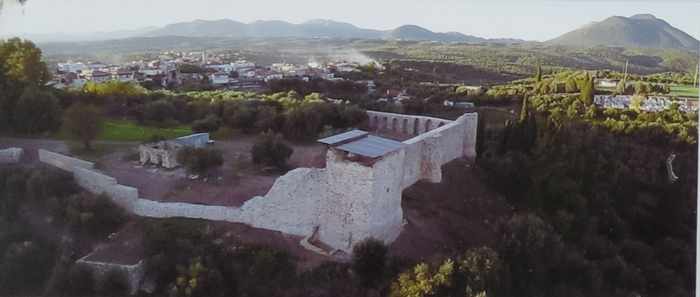
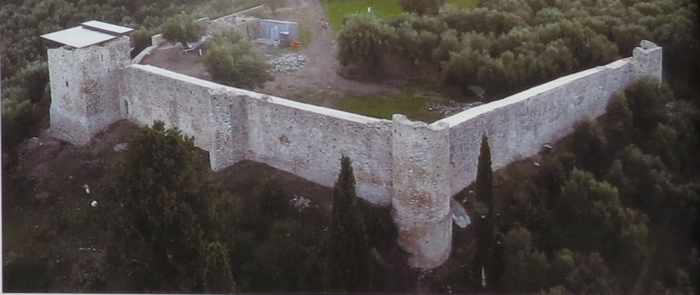
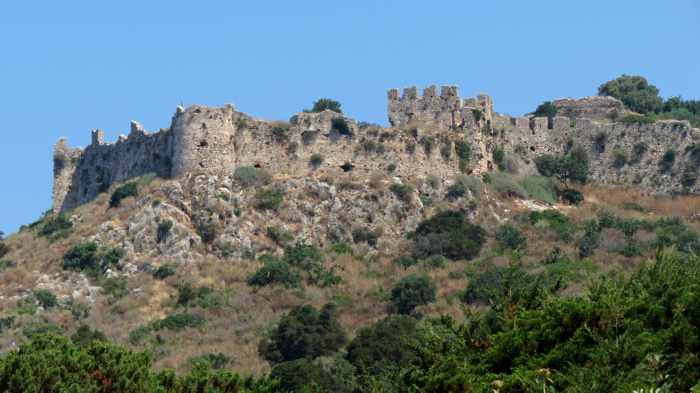
    Walls on the southern side of Palaiokastro, the Old Castle of Navarino, which was built in 1278 near the town of Pylos in the Peloponnese
     

    Old Castle of Navarino

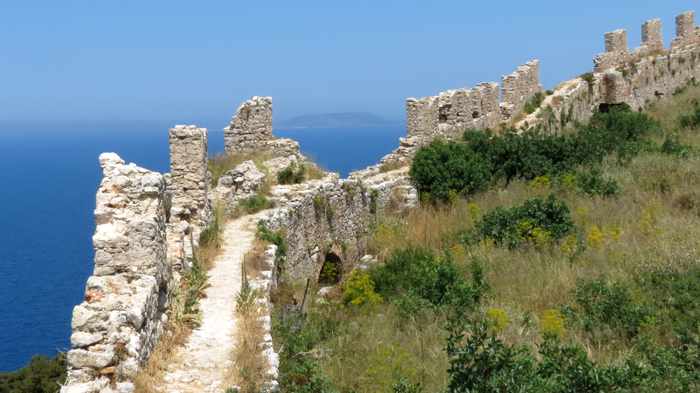
    Though parts of the castle walls have collapsed, you can walk atop some of the remaining sections, such as this one high above the Ionian Sea
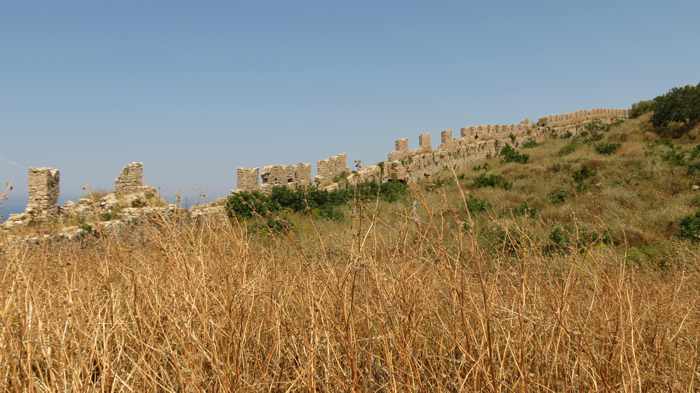
     

    Old Castle of Navarino

    Walking inside the walls can be difficult — even perilous in places —  if you stray off the main trail or try to take a shortcut from the west wall to the east, as we did. The castle’s south yard is overgrown with shrubs and prickly bushes, and the ground is covered with loose rocks and stones that wobble and roll underfoot.
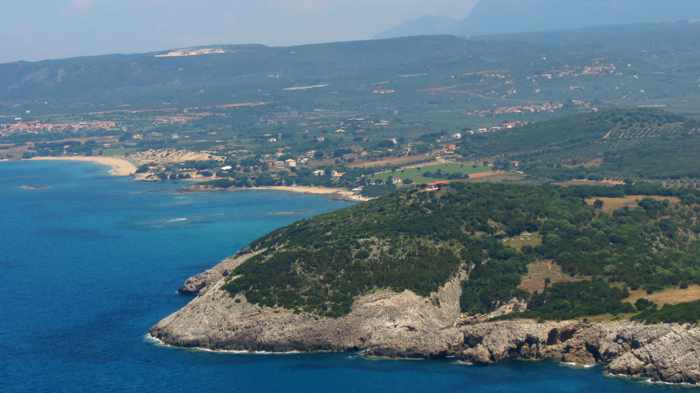
     

    Old Castle of Navarino

    The big payoff for those people who make it all the way up to the northeastern corner of the castle: The incredible views of the Ionian Sea, Navarino Bay and the beautiful Messenian coast …
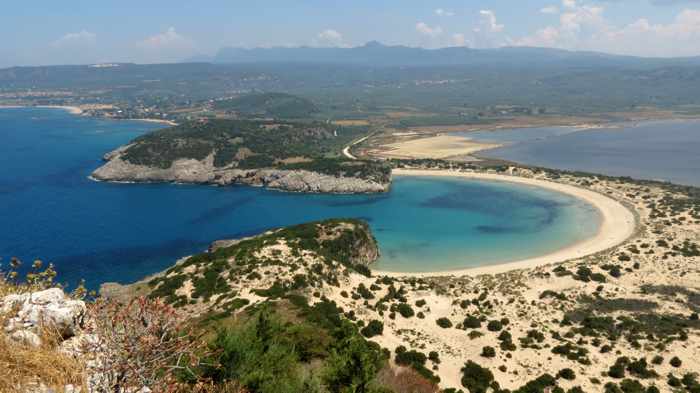
     

    Voidokilia beach

    … and, most impressive of all, the stunning Voidokilia beach


    Scenic trek: Built 740 years ago, the Palaiokastro / Old Castle of Navarino is certainly showing its age.

    Its hilltop exposure to the elements, plus hundreds of years of neglect, have taken a severe toll. The outer walls are crumbling — some sections have collapsed, while others appear ready to tumble anytime  — and only ruins remain of the buildings that once stood inside. Those structures have been reduced to rubble; the former walls and foundations are now boulders, stones and rocks scattered across the ground. The two castle yards are almost entirely overgrown with shrubs, prickly plants, tall grasses and trees that obscure most of the fortress’s interior. It’s possible to walk on some of the outer walls, and dirt paths wind through parts of the grounds, but it can be dangerous to step off the main trails —  the  rocks underfoot tend to shift and wobble as you walk over them, so there’s a constant risk of slipping and falling or twisting an ankle.  

    Because of the ancient castle’s derelict condition, plus the ever-present possibility of loose stonework falling from its weathered walls, the Palaiokastro is supposed to be out of bounds to visitors. There’s no fencing to keep anyone out, and no security guards to stop people from entering — just a solitary sign warning that “The Castle of Navarino is closed due to serious danger.” But that doesn’t deter thousands of tourists from visiting the site every year. 

    For most, it’s the breathtaking “must see” views that attract them — especially the castle’s unrivalled vantage points for photographing the incomparable and immensely Instagrammable Voidokilia beach.

    That’s the main reason why I climbed up to Palaiokastro during our trip through the Peloponnese in May 2017  — I wanted to experience, in-person, the outstanding Voidokilia beach views that had fascinated me in many travel photographs and videos I had seen over the years.


    [adToAppearHere]


    To be honest, I didn’t know the castle was closed, and I also didn’t see the “danger” sign at the bottom of the access path. (My hiking companions did, but they never mentioned it.)  I had read about Palaiokastro on a few travel websites, and knew that it consists mainly of defensive walls enclosing crumbled ruins, but none of the articles had said anything about the castle being closed or possibly dangerous to visit. Some sites even described it as a not-to-be-missed historical attraction. I figured it would take some effort to reach, since it’s situated atop a craggy hill a few hundred meters high. But once up top, I expected that it would be relatively easy to walk around, like the marvellous Methoni Castle which we had visited just the day before (see my post: A walkabout in Messenia’s 800-year-old Methoni Castle for an account of that.)  So when we found the castle access path at the northwest end of Divari beach, I was eager to head up for a look around.

    To continue reading and to see more photos of Palaiokastro, please click on the link under the video below to turn to page 2.


    This video by AllMessinia takes you on a short flight above Palaiokastro, while subtitles provide historical information about the monument


    CONTINUED ON PAGE 2
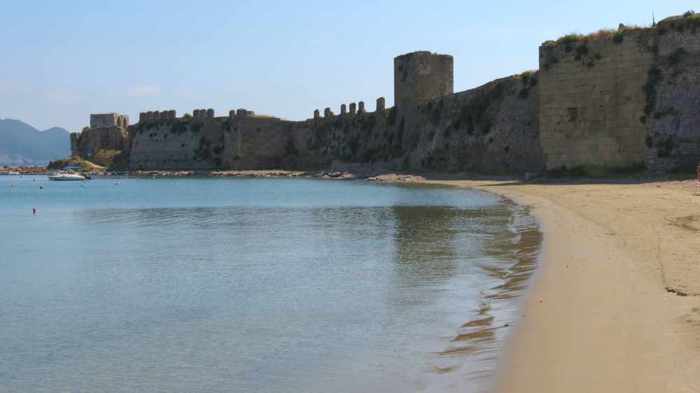
  • A castle- and seaview lunch break at Methoni beach

    Share

    Methoni Castle and Methoni beach

    Our lunch at Akrogiali Taverna in Methoni was served with three lovely views, including the historic Methoni Castle to our right …


    Methoni Bay

    … Methoni Bay and Sapientza Island directly in front, and …


    Methoni beach

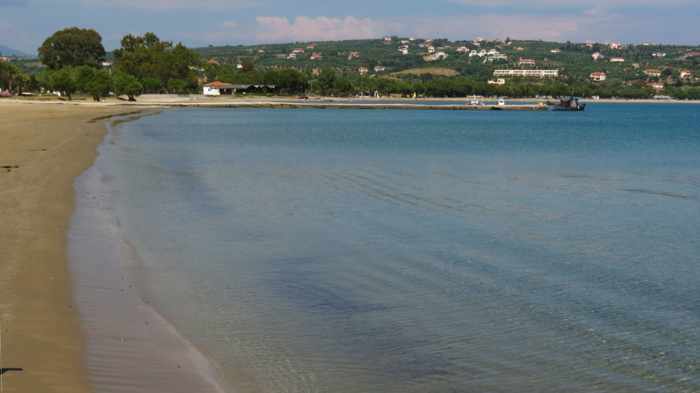
    … the golden sands and turquoise waters at the town beach to our left


    Seaside dining: It was a huge treat to have lunch in the town of Methoni after visiting the area’s leading historic attraction for a few hours (which I described in my recent post,  A Walkabout in Messenia’s 800-year-old Methoni Castle).

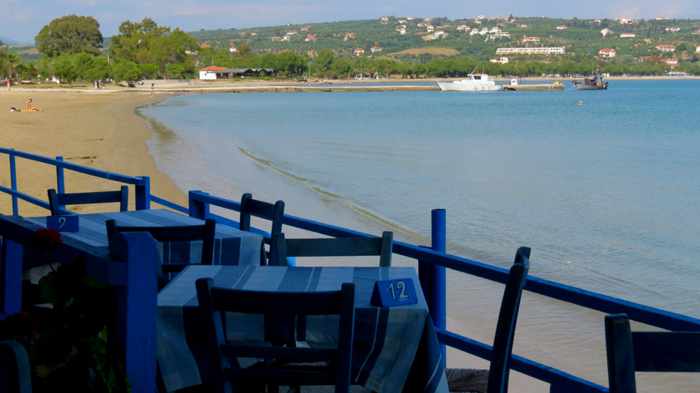
    What made our lunch break so special wasn’t just our feast on fabulous Greek fare, but the beautiful views we got to enjoy from our seaside seats at Akrogiali Taverna. From our table a mere meter from the water’s edge, we could gaze at Methoni’s golden sand beach, its picturesque bay and small harbour, and the imposing stone walls of the ancient castle. 

    That kind of restaurant location and scenic backdrop is simply impossible to find anywhere back home in Toronto. Even though our city boasts an enviably long waterfront on Lake Ontario and a clutch of small islands with extensive parkland just a short ferry ride from downtown, we can’t dine right beside the water anywhere (not even on the Toronto Islands), and there are no centuries-old historic places along the shoreline. (Toronto is a young city by European standards — it was incorporated only in 1834).

    The unique experience of open-air dining at a beach or seaside taverna with a scenic view is one of the main reasons why we love travelling to Greece so much, and our visit to Akrogiali was the first such meal of our 2017 spring holiday.  It really hit the spot given that it had been over 11 months since we had last been to a beach taverna.  


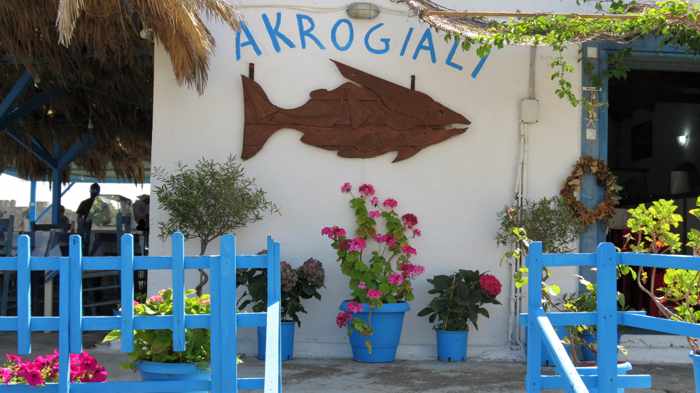
    Akrogiali Taverna in Methoni

    Beach view of the entrance to Akrogiali Taverna


    After walking around Methoni Castle in the hot sun for more than two hours, and then strolling through part of the town of Methoni, we were looking forward to cooling off in the shade and having a good lunch. We found a couple of options on the Methoni beachfront, but liked the look of Akrogiali the best, so we got a table there.

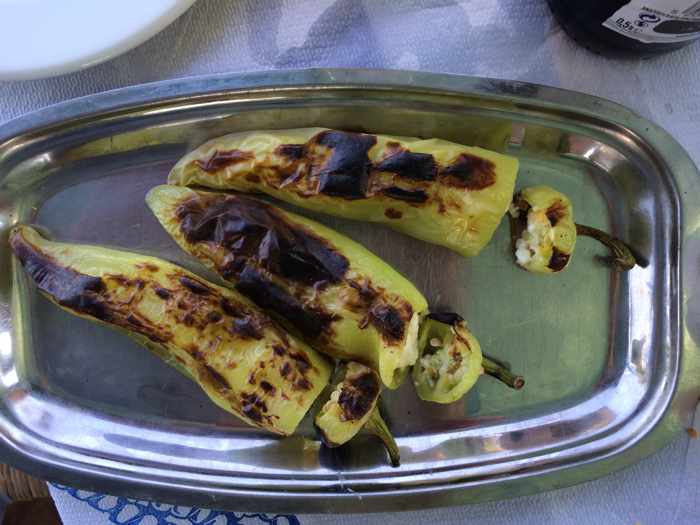
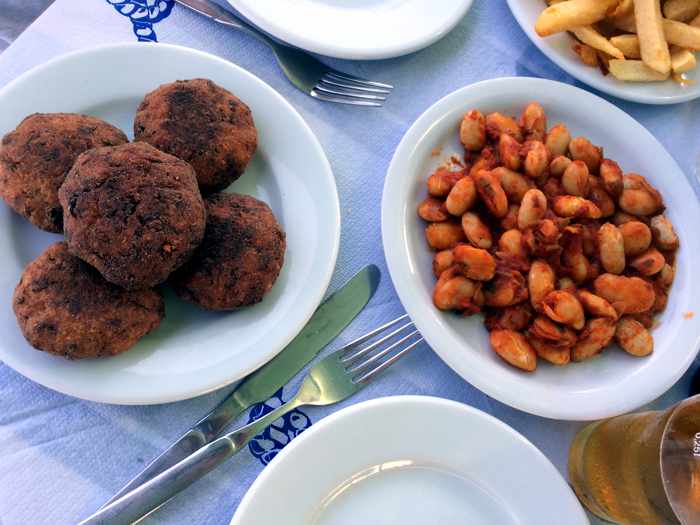
    Our lunch was just as delicious as the scenery: Greek salad, gigantes (giant beans baked in a tomato sauce), kolykythokeftedes (zucchini fritters), piperies me tyri (grilled peppers stuffed with a spicy feta), keftedes (Greek meatballs), a platter of gavros (small grilled fishes) and a big plate of fried potatoes.

    With the calming views, light sea breeze and the sound of waves lapping against the sandy beach, it was pure bliss. I would have been happy to spend the rest of the day there, drinking wine and nibbling mezes while watching swimmers and boats in the bay, and looking at the castle.

    Below are more photos of our lunchtime view and three of the dishes we enjoyed. If you would like to read what other people have thought of the restaurant, you can find more than 100 reviews under the Akrogiali Taverna listing on TripAdvisor.


    Akrogiali Taverna

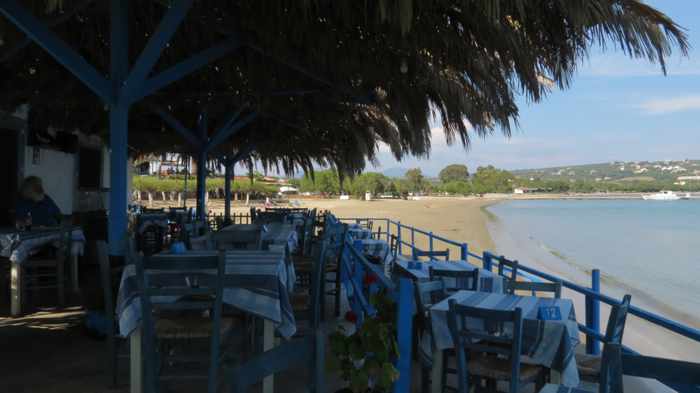
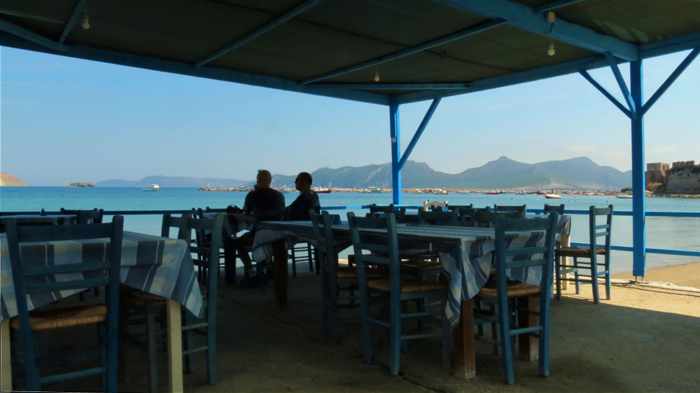
    Part of the large open-air dining terrace at Akrogiali


    Akrogiali Taverna

    Tables along the edge of the patio offer unobstructed views of Methoni beach and bay


    Akrogiali Taverna in Methoni

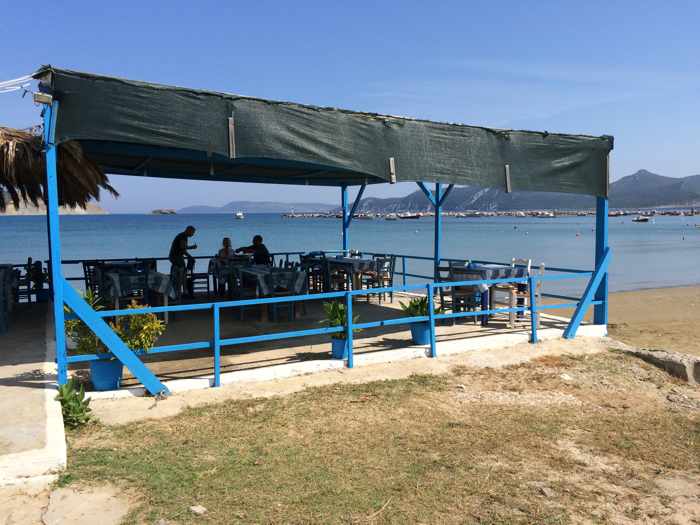
    Side view of part of Akrogiali’s large, shaded patio


    Akrogiali Taverna in Methoni

    The taverna is less than a 5-minute walk from the Methoni Castle entrance


    Akrogiali Taverna

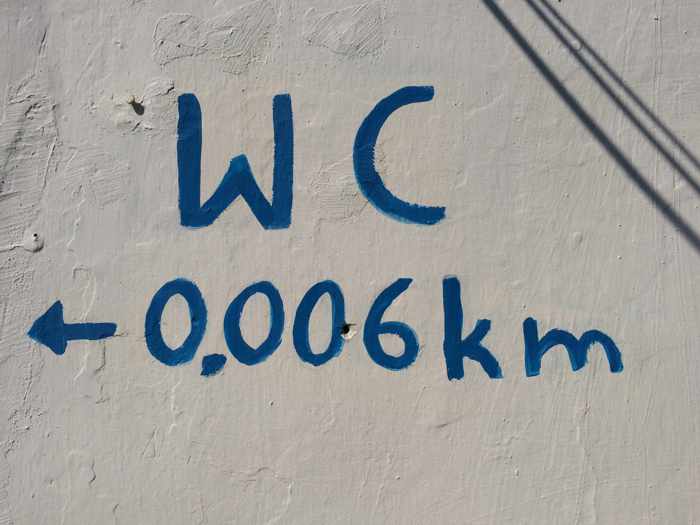
    Toilet humour: a sign on the taverna wall points the way to the restrooms. They were only 30 steps from our table.


    Akrogiali Taverna's grilled stuffed peppers

    The piperies me tyri (grilled peppers stuffed with a spicy feta cheese)


    Akrogiali Taverna in Methoni

    Kolykythokeftedes (zucchini fritters) and gigantes (giant beans)


    Methoni Bay

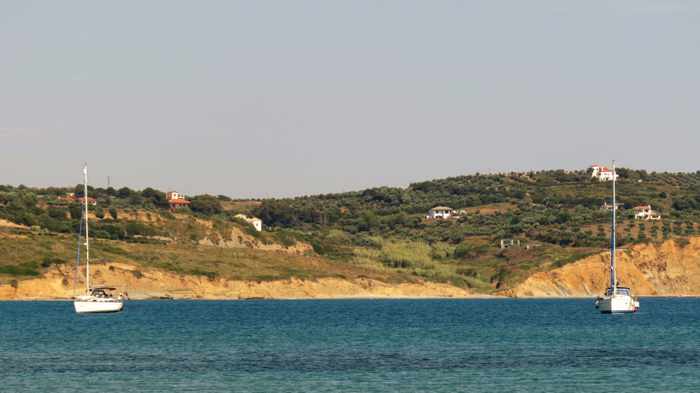
    Sailboats in Methoni Bay


    Methoni Bay

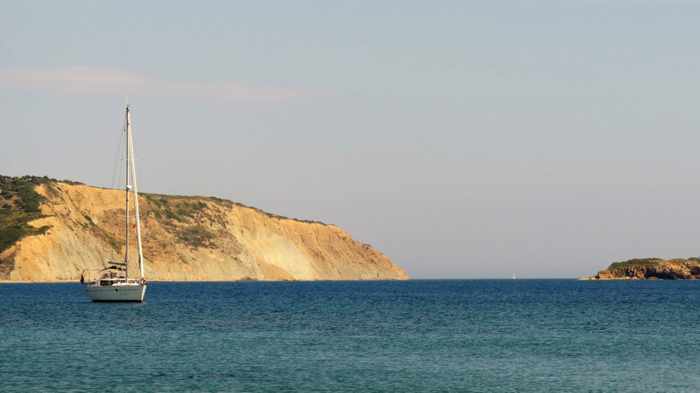
    View toward the mouth of the bay and Kouloura islet


    Akrogiali Taverna in Methoni

    Customers enjoying the view from Akrogiali’s patio


    [adToAppearHere]

  • A walkabout in Messenia’s 800-year-old Methoni Castle

    Share

    Methoni Castle

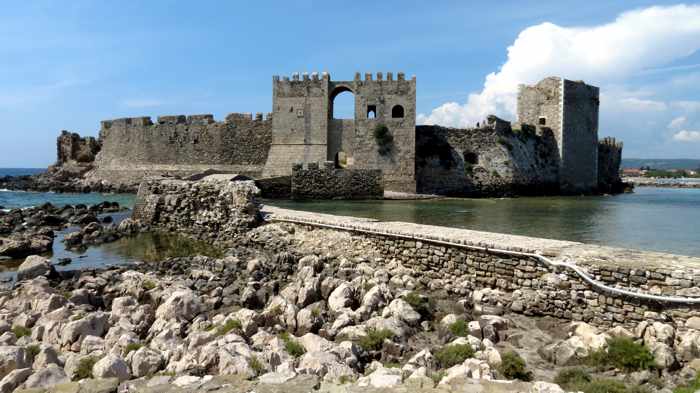
    The southern fortification walls of Methoni Castle, viewed from the Venetian-era Bourtzi fortress (below)


    Bourtzi fortress of Methoni Castle

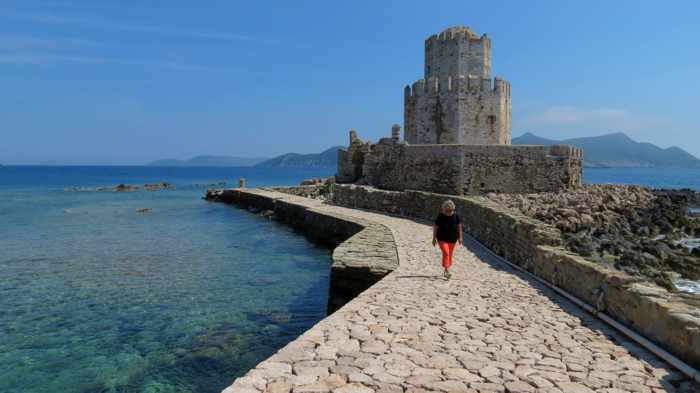
    The Venetians built the octagonal-shaped Bourtzi fortress on a rocky islet connected to the castle by a stone-paved causeway


    Methoni meanderings: Day 2 of our western Peloponnese road trip turned out to be rather “monumental” for us, figuratively speaking, as our travels took us to churches, archaeological sites and castles — some more than 800 years old — plus a place where two major Greek maritime conflicts occurred.

    Our drive to and through hundreds of years of history took us first to the Byzantine Church of Samarina, which dates from the 12th Century, followed by a walk around the ruins of the Castle of Androusa, which was built in the 13th Century.

    Next stop was the town of Pylos on Navarino Bay, where two of the most significant naval combats in Greek history took place:  the Battle of Pylos which was fought in July of 425 B.C. during the Peloponnesian War, and the October 20 1827 Battle of Navarino, the most pivotal and decisive event of the Greek War of Independence from Turkey.  Besides observing the bay from a variety of vantage points in and around Pylos, we managed to see some of the exterior fortification walls of the impressive Neocastro (Castle of Pylos), which was built in 1573. Unfortunately, we didn’t have time to go inside to tour the castle interior and see its remarkable hexagonal citadel.

    Our final sightseeing stop was the town of Methoni, where we paid an afternoon visit to the majestic Methoni Castle.

    Constructed in 1209 by the Venetians, Methoni Castle occupies a sprawling site encompassing nearly 38 hectares.  The castle is so big we couldn’t explore every sector during the two hours we walked around, but we did cover a lot of ground, and managed to see the highlight attractions, including the Bourtzi sea fortress, the Ottoman baths, and the Church of the Metamorphosis Sotiros. (We might have spent more time meandering through the ruins had it not been so sunny and hot.)


    Methoni Castle

    The stone bridge and entrance to Methoni Castle


    Methoni Castle

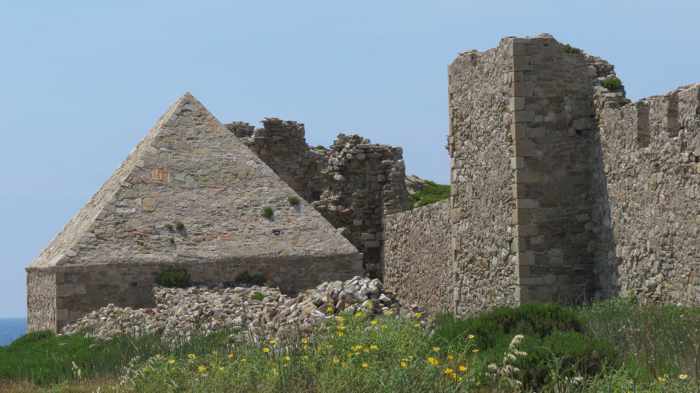
    This pyramid-roofed building was apparently used to store munitions. The inner castle wall beside it is crumbling in places, but visitors can still walk on the top to get views of the entire castle site.


    Methoni Castle

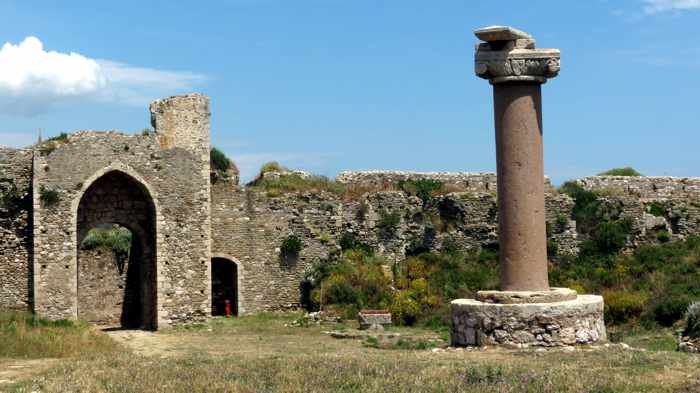
    A curiosity inside the castle is a tall, red granite column topped with a Byzantine-style capital. Often called “Morosoni’s Stele,” the column is believed to have been topped with either a sculpture of the winged lion of Venice, or a bust of the Venetian Doge Francesco Morosini.


    Methoni Castle Turkish baths

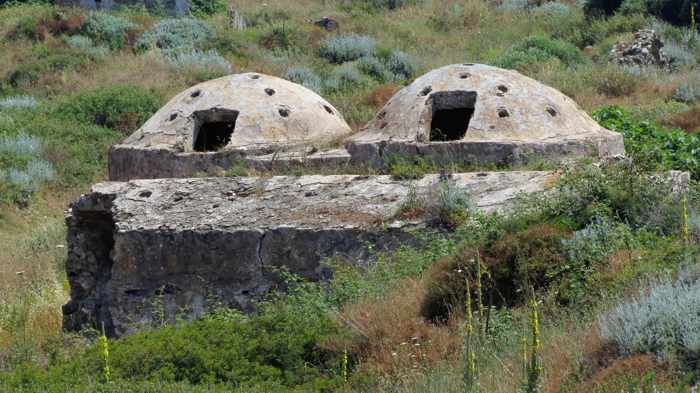
    The round, domed roofs of the former Turkish baths (hamam) 


    Methoni Castle

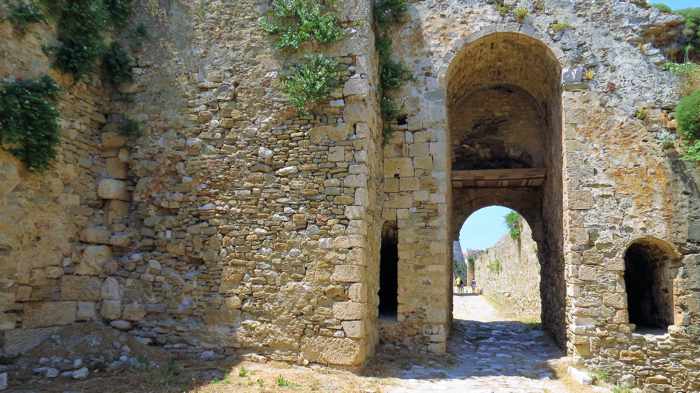
    A tall, arched passageway inside the fortification walls


    Methoni Castle church

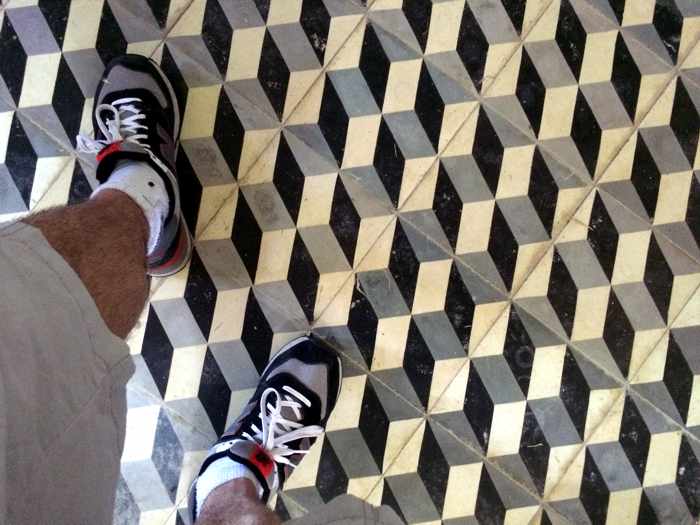
    One of the patterned floors inside the Church of the Metamorphosis Sotiros


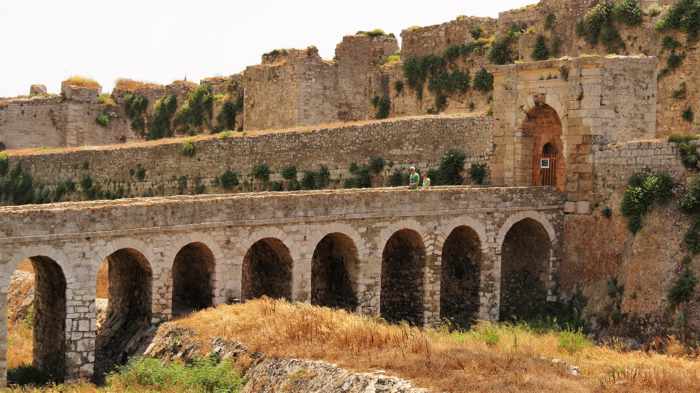
    My favourite castle features were the elegant stone entrance bridge (built by the French in 1829 to replace a wooden drawbridge), the Bourtzi fortress, the interior of Metamorphosis church, and the breathtaking 360-degree views from atop one of the main inner walls. I also was fascinated by the variety of shapes and angles that architects had chosen when designing the castle’s imposing fortification walls and the buildings they protected. These included rounded and pointed archways, square and rectangular houses and public buildings, an arsenal with a pyramid-shaped roof, the octagonal Bourtzi fortress, sloped and vertical defensive walls, and the round, spaceship-like domed roofs of the hamam (Turkish baths) built by Ottoman occupiers.

    Admission cost only €2 per person, by the way — a bargain, considering the size of the castle.

    Below is a brand-new aerial video of Methoni Castle that was published, coincidentally enough, right while I was putting this post together. On page 2 you can view some of the photos we shot while meandering through the ruins. If you’d like to read more about the history of Methoni Castle, click here to read a detailed description from the Kastrologos Castles of Greece website.


    The grandeur and vast size of Methoni Castle are captured in this aerial video published February 28 2018 by George Magoulis


    CONTINUED ON PAGE 2
  • The quiet end of Divari, the mile-long golden beach in Messenia

    Share

    Divari beach on Navarino Bay

    A bend near the northwest tip of Divari, also known as Golden Sands Beach


    Divari beach on Navarino Bay

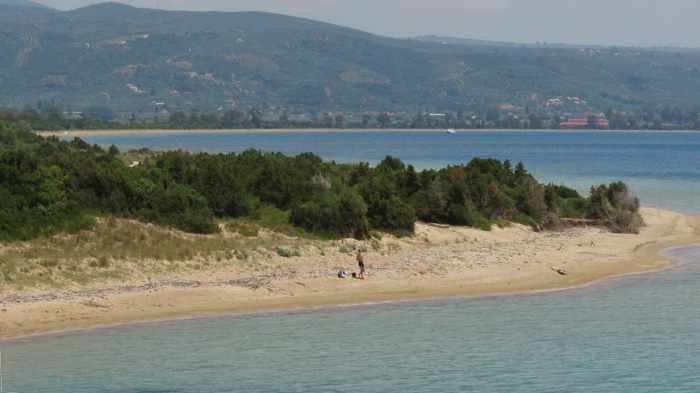
    The shallow bay between Divari beach and Sfakteria Island


    Delightful Divari: Sunshine, warm temperatures, two beautiful sandy beaches, a crumbling ancient castle and superb Greek food.  Combine those ingredients and you’ll cook up a perfect vacation day in Greece — as we discovered during our 2017 spring holiday in the western Peloponnese.

    I recently wrote about our bucket-list visit to Voidokilia, one of the beaches we got to see on the third day of a  road trip through Messenia. The other beach we enjoyed was Divari (Ntivari in Greek), an enticing ribbon of golden sand that curves along the northwestern coast of Navarino Bay near the town of Pylos.   (I will tell you about the castle and food another time.)

    Divari was the first stop on our agenda, since it would bring us close to a footpath leading to the ruins of the old Castle of Navarino,  a.k.a. Paleokastro, an historic site we were keen to explore. To get there from our hotel base in Marathopoli, we drove down the two-lane Kyparissia-Pylos highway (Route 9) to the village of Gialova, where signs directed us to the Divari access road. 


    [adToAppearHere]


    The beach extends a considerable distance — approximately 1.5 kilometers, in fact — and sections are visible from the dirt road that runs its full length. Evergreen trees, bushes, and dunes block some views of the beach, but open areas between the trees reveal plenty of tempting places to spread a towel or a mat. If you want to sit on a chair or under the shade of an umbrella, though, you have to bring along your own gear — unlike many popular beaches in Greece, Divari is not organized with rows of rental lounge chairs and umbrellas, and isn’t lined with beach bars and tavernas.

    Please click on the link under the video below to continue reading and see more photos of Divari beach.


    This aerial video by Manolis Gialyrakis features great views of Divari beach and a shipwreck close to the shore


    CONTINUED ON PAGE 2
  • Even in severe winter weather, Greece’s scenic beauty shines through

    Share

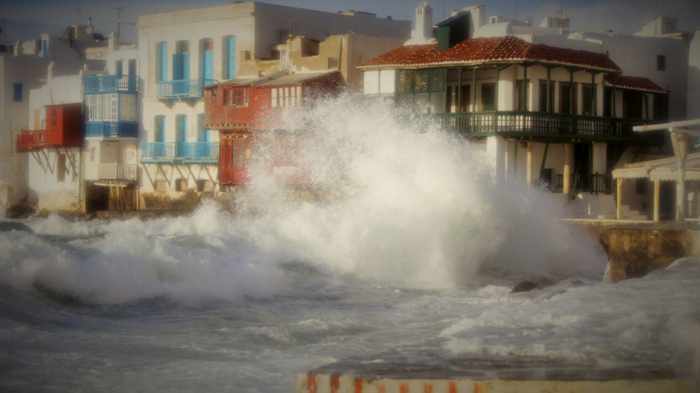
    Little Venice Mykonos during January storm

    Surf sprays two storeys high as roaring waves crash ashore at the Little Venice area of Mykonos Town, flooding the entire seaside strip of cocktail bar terraces. This photo was posted on the Mykonos LIVE TV Facebook page on January 18, the day gale-force winds raged across much of Greece.


    Storm scenes: When wild winter weather swept across Europe this week, Greece wound up in the path of powerful winds that pounded some places, including Syros island, with gusts reaching as high as 122 kmh — the equivalent to force 12 on the Beaufort wind scale.

    The fierce winds raged relentlessly on Thursday January 18, toppling trees on several islands, damaging one of the iconic windmills on Mykonos, and preventing planes from landing at Syros airport. The storm disrupted ferry travel and shipping, too, as rough seas forced the cancellation of many sailings as well as the closure of the ports at Lavrio and Rafina. At Piraeus port, the passenger ferry Panagia Agiasou broke away from its moorings during the tempest, while waterfront areas at Mykonos Town, and Kini Beach on Syros, sustained damage from massive waves that walloped the shore.


    [adToAppearHere]


    Although most residents stayed indoors to avoid the incessant blasts of wind, which made walking perilous and even driving difficult, some did venture out to observe nature’s fury and photograph the stormy conditions. I found numerous pictures and videos on social media showing skies filled with massive dark clouds, and huge waves crashing onto seafronts and beaches in Mykonos, Paros, Naxos, Syros, Rhodes, Lesvos, Samos, Skyros, Skopelos, Ithaca, Paxos, Kefalonia, Nafplio, Athens and elsewhere. Many of the images showed that, even in ferocious weather, the scenic beauty of Greece’s coastal areas still stands out.


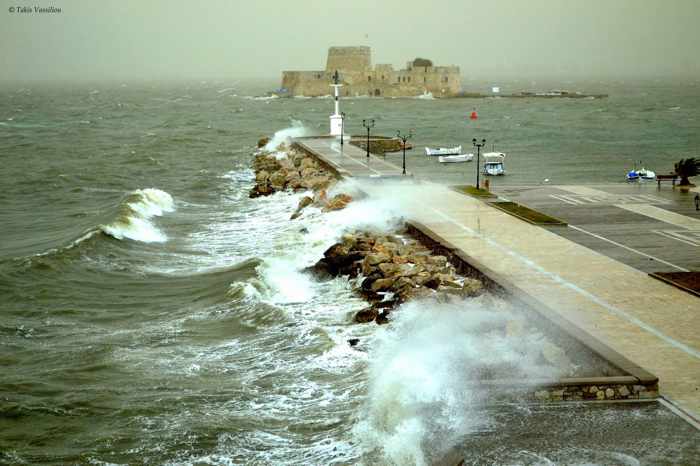
    Nafplio photo by Nafplio Kalimera

    Takis Vassiliou shot this view of the Nafplio waterfront and Bourtzi sea castle, and shared the image on his Nafplio Kalimera page on Facebook


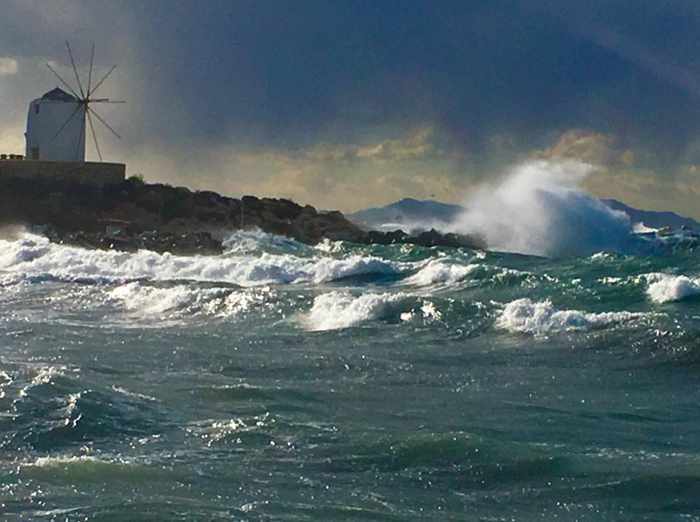
    Paros photo by Waves on the seafront at Parikia on Paros photo shared on Facebook by ΠΑΡΟΣ like Facebook page

    Maria Alipranti captured sunlight illuminating stormclouds and waves at the Parikia waterfront on Paros. Her photo, and more than 20 others she shot, were shared on the ΠΑΡΟΣ like page on Facebook.


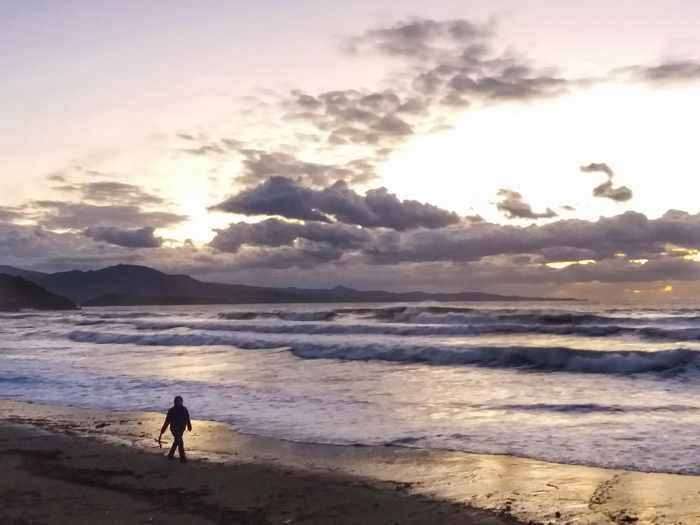
    Stormy sky on Lesvos photo by Eleonaora Pouwels

    Eleonora Pouwels photographed this scene of waves, stormclouds and sunset at Psiriara beach on Lesvos 


    Please click on the link below to turn to page 2, where I have posted more photos and several videos that were shared on social media.

    CONTINUED ON PAGE 2
  • A bucket list visit to Voidokilia, the extraordinary Ω-shaped beach in the Peloponnese

    Share

    Voidokilia beach

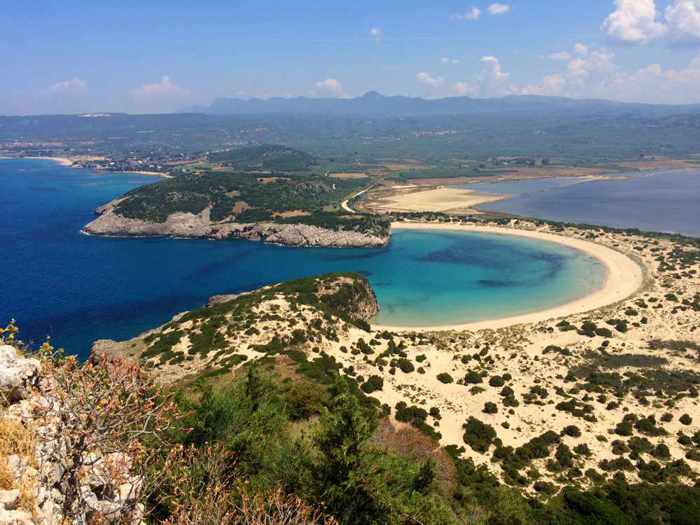
    I got my first in-person peek at beautiful Voidokilia beach from this breathtaking vantage point in the ruins of the Castle of Navarino …


    Voidokilia beach

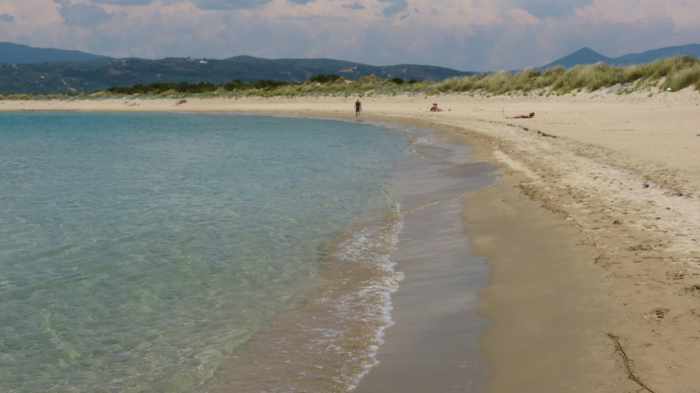
    … and shot this picture two hours later while walking along Voidokilia’s amazing arc of soft brown sand 


    My Omega moment: I’m a big fan of beaches, as you’ve probably gathered from perusing my blog posts. I love looking at them, walking on them, and of course taking photos of them. It doesn’t matter if they consist of soft sand, pebbles or stone; are situated in secluded coves, scenic bays or along lengthy stretches of coastline; or face onto calm water, rolling waves  or rough seas — they all make me happy. I can’t explain exactly why, but there’s something about beaches that makes me feel surprisingly calm yet incredibly invigorated at the same time. (Mountains have the same effect). It’s no wonder I love Greece so much: since the country is blessed with myriad beaches on its islands and mainland coasts, I feel great wherever I go. (Greece has mountains aplenty, too, but I’ll write about those another time.)

    Although there are dozens of must-see places on my Greece travel wish list, only 13 are beaches per se (though many of the other spots are located at or near beaches I’d love to visit). All are stunning, some are world-famous, and each has  a unique appeal, distinctive feature or superlative natural beauty I want to witness in person at some point during my lifetime, even if only briefly or from afar.

    My beach bucket list (no pun intended)  includes five on Crete — the Balos lagoons, plus Preveli and Vai, Matala, and Stefanou/Seitan Limania;  Navagio (better known as Shipwreck Beach) on Zakynthos; Porto Katsiki on Lefkada; Myrtos on Kefalonia;  Simos on Elafonisos island in the Peloponnese; Manganari on Ios; Papafragas on Milos, and Agios Demetrios on Alonissos. Though not technically a beach, the Giola lagoon on Thassos is right up there, too.

    Until last spring, there had been 14 beaches I particularly wanted to see, but last May I finally got to visit the incomparable  Voidokilia in the Messenia region of the Peloponnese. 


    [adToAppearHere]


    Voidokilia first enthralled me in 2011 when  the Greek National Tourism Organisation published an aerial photo in the Beaches Album on its Visit Greece Flickr page. Voidokilia’s semicircular arc of light brown sand, strikingly similar in shape to the Greek letter Omega Ω, seemed surreal and almost other-worldly.  It looked too perfect to be natural. I instantly wanted to see it, but didn’t foresee having the opportunity anytime soon. We had been hooked on island hopping at the time, and didn’t have a Peloponnese holiday in our near-term plans. But in 2016 we finally made our first foray into that part of Greece, visiting several places in the eastern Peloponnese, and we paid the region a return visit last year to explore some of its southern and western reaches. I was excited when I discovered that Voidokilia was one of the top attractions on our scheduled driving route along the Messenian Gulf coast.

    Since Voidokilia was the first bucket list beach I was going to see, I nervously wondered if it would live up to my lofty expectations.  But it  didn’t disappoint. If anything, it made an even better impression than I had imagined. I gasped when I first observed Voidokilia from a lookout point in the Navarino Castle, and when I later walked along its soft brown sand a short time later, and gazed  across the sparkling turquoise bay it encircles,  I felt like I was living a dream. I was utterly gobsmacked, as some Brits might say. I now like to describe the experience as a personal OMG moment — though I pronounce it O-Me-Ga instead of Oh-My-God (pun intended this time).  I savoured every second I was there, and now consider Voidokilia one of my favourite beaches anywhere in the world. I will go back again.

    I did take plenty of photos, of course, but I’m not entirely happy with how they turned out — they simply don’t make Voidokilia look as stunning as it actually appears in person.  I suppose I was just too busy enjoying the moment and the captivating scenery around me to pay more attention to what I was doing with my camera. I have posted some of the images on page 2, so you can be the judge. But I really think you should just go and see Voidokilia for yourself. It truly is a marvellous sight.

    Below is a video that I believe does do justice to Voidokilia’s striking beauty. Beneath that is a link to page 2, where you can see our photos as well as a few more videos of this fantastic place in the Peloponnese.


    This 5.5-minute film from Studio Gaël Arnaud features stunning drone views of Voidokilia as well as the hilltop Paleokastro (Castle of Navarino) from which I shot some of my Voidokilia beach photos in May 2017.


    CONTINUED ON PAGE 2