Author: admin (Page 37 of 109)

SkyGreece launches new website with online booking

Share

SkyGreece Airlines

A screen capture of the home page for the new SkyGreece Airlines website, which went live today (April 7 2015)


Travellers curious to check SkyGreece Airlines fares and schedules, or book seats, can do so online now that SkyGreece has launched a new website.

The airline announced on Facebook today that its new site — featuring fast and easy online booking — has gone live.

The new site makes it a breeze to check prices and routes for the airline’s service between Athens, Toronto and Montreal, and between Thessaloniki and Toronto. Since March 21, when SkyGreece first announced that flights were available for booking, customers had to phone an airline reservation representative or contact a travel agent to obtain further information.

Out of curiosity, I checked fares and availability for the dates I am already booked to travel to and from Greece next month, and discovered I would have saved about $100 flying economy class on SkyGreece.

The airline offers three fare categories: economy, “economy flex” and premium.

I have reported extensively on SkyGreece Airlines … click here to see my previous posts.

Delightful moments on Naxos

Share

NAXOS from Kassiani Koufaki // on Vimeo


It’s no secret that we love Naxos. We picked it as our Destination of the Year in 2013, and I have been happy to see Our Top 15 reasons to visit Naxos has been one of the most-read posts I have published to date.

As you can probably imagine, I’m always keen to view photos and videos of Naxos, particularly to see how other travellers have enjoyed and experienced this remarkable island. This short video called Naxos, by Kassiani Koufaki, is one of my all-time favourites.

Though it’s only a minute and a half long, it captures dozens of delightful sights and enchanting travel moments on the island.  It brings back many warm memories for me personally, since I’ve seen many of the scenes in person. But I think people who haven’t yet been to Naxos will also enjoy its brief glimpses of beautiful scenery and simple details that make it such a pleasure to visit.

Must-see sights in and around Rethymno on Crete

Share

Guest post by the Cretico blog

Rethymno is the third largest city in Crete and one of the most beautiful in Greece. Byzantine churches and monasteries, renaissance monuments, caves, countless beaches and enchanting villages throughout the province, await the visitor to wander and admire them.

The Old City
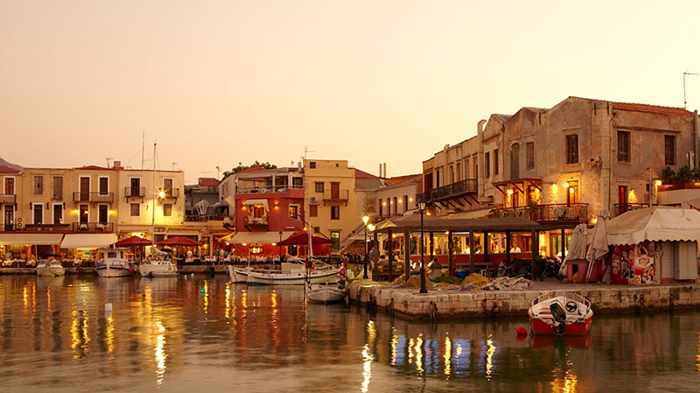
Rethymno in Crete

The oriental influence of the Turkish occupation, combined with the Venetian architecture of the Renaissance, compose the beautiful picture of the old town of Rethymno. Taking a walk through the narrow streets of the historic center, you can see many Venetian and Turkish monuments. From the Venetian harbor and the famous lighthouse, you can reach the Venetian Fortezza castle. The arches of the Venetian Loggia will definitely impress you. After a while, you will have the chance to rest and drink fresh water from the Rimondi fountain with three spouts in the shape of a lion, built in 1626 by rector Rimondi.

A stop at the Historical – Folk Museum of Rethymnonn with its historical exhibits, is definitely not a waste of time. Continuing your tour in the old town, you will admire the church of San Francesco, you will pass through the Great Gate and will reach the main square where you will admire the various public buildings. The old city is the living history of Rethymno, it turns you back in time and invites you to visit it.


The Fortezza Castle
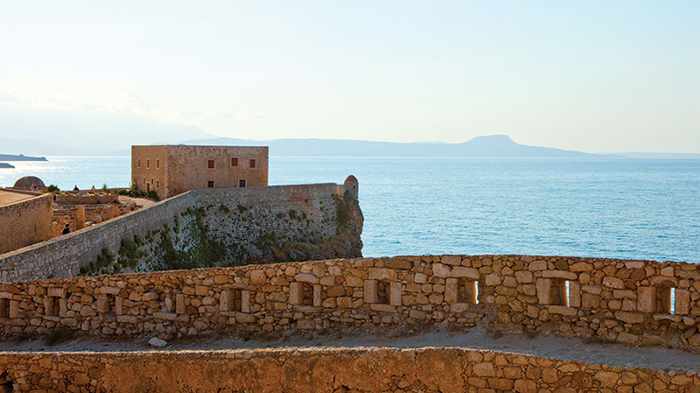
Fortezza Castle

Undoubtedly, one of the most prominent highlights of Rethymno is the unique Venetian castle Fortezza. This is the Venetian castle that dominates the hill of Paleokastro, in the heart of the city and is famous as the largest Venetian castle ever built.

In the same place, in ancient times, was built the citadel of ancient Rirthymna and the Temple of Artemis, which have not survived. After the city was looted by the Algerian pirate Ouloutz Ali in 1571, was created the need for a good fortification. That’s why in 1573 was built the majestic pentagonal fort, according to all the modern methods of fortification and was designed so that it could shelter the entire population of the city.

Its premises, many of which are preserved in good condition until today, included barracks, a church, hospital, warehouse, the residence of the Directors, the residence of the Rector and a luxurious and stately building in the central square of the fortress. In the fortress of Fortezza takes place, in the summer, the Renaissance Festival of Rethymno, which attracts many visitors to Rethymno.


The Archaeological Museum of Rethymno
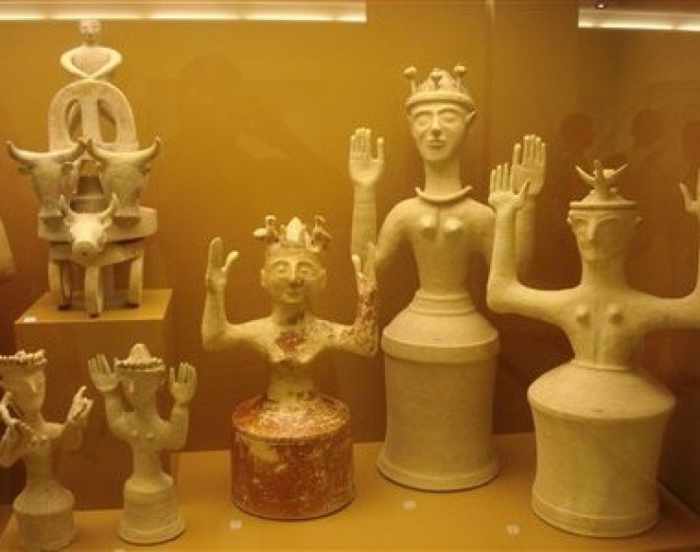
Archaeological Museum of Rethymno

In front of the main gate of Fortezza is the Archaeological Museum of Rethymno, since 1887. It is housed in a pentagonal Ottoman building that was built for the protection of the entrance of the east gate of Fortezza.

Here are displayed findings of the Early Minoan, Middle Minoan and Late Minoan times, such as various pots, tools, weapons, pottery, jewelry, signets, and clay figurines, such as this of a female figure known as the “goddess with upraised hands”. The visitor can also admire various objects and artwork of the Classical, Hellenistic and Roman period, such as gold jewelry, glass vases and collections of sculptures from various regions.

Among others, the Museum displays an interesting collection of coins from different historical periods of time.


The Monastery of Arkadi
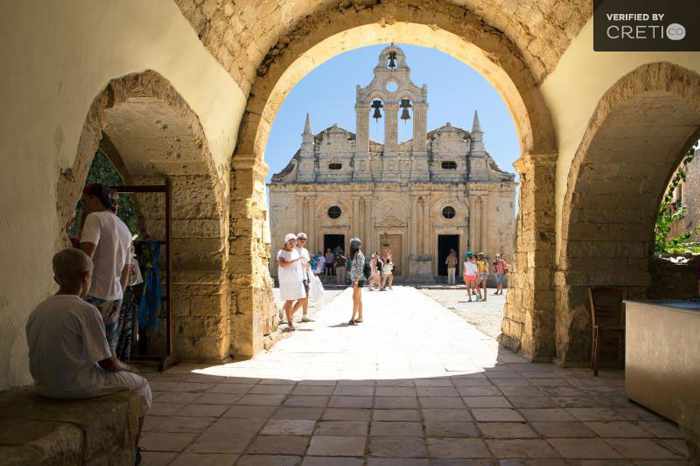
Monastery of Arkadi

One of the highlights of Rethymno which deserves a visit is the Monastery of Arkadi, one of the most important monasteries in Crete, situated 23 km from Rethymno, in a strategic location on the northwest side of the mountain Idi.

The name of the monastery comes from the Byzantine Emperor Arcadius and its foundation dates back to the 5th century. The Monastery of Arkadi became known worldwide as it was strongly involved in the liberation struggles against the Turkish conquest. On November 8, 1866, the defenders of Crete who were sheltered in the monastery, blew alive in order not to surrender to the Turks. This event is known in history as the “Holocaust of Arkadi Monastery” and for this reason, this place has been characterized by UNESCO as a European Freedom Monument.

After the destruction, the monastery was completely rebuilt and restored to its original form, although the burned-out temple, and a cannon ball, wedged in a cypress, witness its history. Visitors can admire the two-aisled church in the center of the monastery dedicated to Saint Constantine and the Transfiguration of the Savior, which was built in the 16th century, the chapel of St. Arkadius, the monastery’s museum hosting exhibits dating from its inception and the powder magazine where the tragedy of 1866 took place.


The Monastery of Preveli

The-Monastery-of-Preveli

The Monastery of Preveli is located about 40 km south of Rethymno and is one of the most famous and respected monasteries of Crete. We don’t know exactly when it was built, but the evidence shows that the first part of the monastery was built in the late 10th to early 11th century, at a time when there was a great development of monastic life in the southern region of Crete.

It consists of two building complexes, the Monastery of Prodromos, in which you will see paintings of the painter Mercurius, and the Monastery of Theologos. It is worth visiting the museum located inside the monastery, which hosts about 100 pictures of priceless religious and historical value. Important exhibits such as a Gospel of 1807, a gilt chalice of 1847, a collection of embroidered vestments, a collection of various ecclesiastical vessels etc., complete the rich collection of the museum. The library of the monastery contains about a thousand volumes of books and other church documents. The Monastery of Preveli is located in a unique natural environment which is almost tropical.


Anogia Village
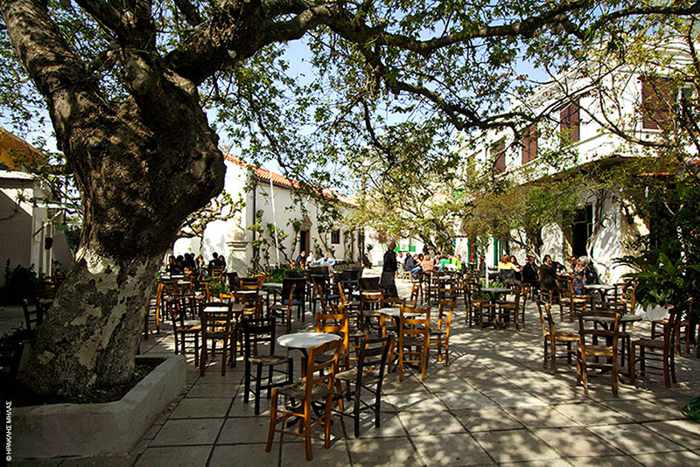
Anogia-Village Crete

The village of Anogia, in Mylopotamos, is approximately 50 km away from Rethymno at an altitude of nearly 800 m. Built on the slope of the hill Armi, with about 2500 inhabitants, Anogia have achieved a tremendous contribution to the national liberation struggle against the Turkish conquest, particularly in the Battle of Crete.

Anogia is also an epicenter of contemporary Cretan civilization. If you visit Anogia, you will be surprised by the traditional textile industry of the place, the reputed embroidery of the village and the use of the loom, which continues even until today.

The Anogians love their heritage and respect the customs and traditions of the place, keep the traditional clothing and language idioms. What remains intense in memory of every visitor of Anogia is the characteristic hospitality of the locals and the excellent care to foreigners.


The Caves of Rethymno

Ideon-Antron-Cave

Another highlight of Rethymno is the 800 caves that exist in the mountains of  the region, which present archaeological and folklore interest. At an altitude of 1538 meters in Nida Plateau in Psiloritis, is the Ideon Andron, a large cave, where, according to Greek mythology, Zeus was raised by Amalthea. Ideon Andron was a cult center during the Minoan years. The excavations have brought to light various findings such as gold jewelry, ceramics and various metal objects.

In the Cave of Melidoni, which was Mercury’s place of worship, the visitors can see the bones of the inhabitants of Melidoni, who died there from suffocation, as they were besieged by the Turks. Also, the cave Sfentoni in Zoniana village, with 14 halls, impresses the visitor with its stalactites and stalagmites. Accessible is also the cave of St. Anthony in Patso, with the beautiful church – dedicated to St. Anthony – located in the cave.


The Renaissance Festival of Rethymno

Rethymno Renaissance Festival

Every summer, in Rethymno, is organized the Renaissance Festival, an institution that has been established since 1987, on the occasion of the great development that the city experienced experienced during the Venetian conquest, in arts, literature and architecture.

The aim of the Renaissance Festival is the preservation and dissemination of the cultural heritage of the city, and the promotion of important Venetian monuments, like the old town of Rethymnon and Fortezza. So far, the Renaissance Festival has presented a variety of important plays of Cretan theater, and other important artists of the Renaissance, such as Shakespeare, Goldoni, Moliere, etc.

The music concerts, involving orchestras and musicians from all over Europe, the opening and closing ceremonies with artistic events, and events organized in various places of the city.


Beaches in Rethymno
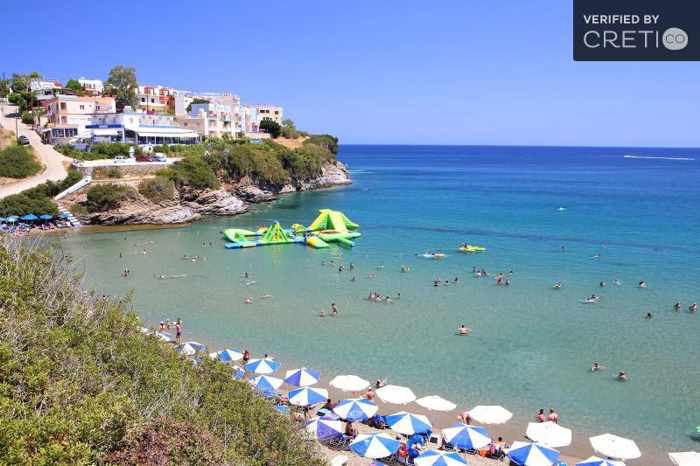
Bali beach Crete

Both in the north coast, and the south, there are many sandy beaches in Rethymno which attract visitors to walk along them, enjoy the sun and swim in the beautiful waters of the Cretan and the Libyan Sea. The beach of Rethymno is a huge, 12 km long sandy beach, which starts from the city of Rethymno and ends in the region of Scarleta.

Near the Monastery of Preveli, there is the homonymous beach, an exotic place with palm trees, crossed by the river Koutalioti and considered by many as the most beautiful beach of Crete. For those who are looking for peace and mental calm, there is the secluded beach of Triopetra in approximately 50 km. south of Rethymno. Within walking distance, you will find the quiet beach of St. Paul, offered for nudism.
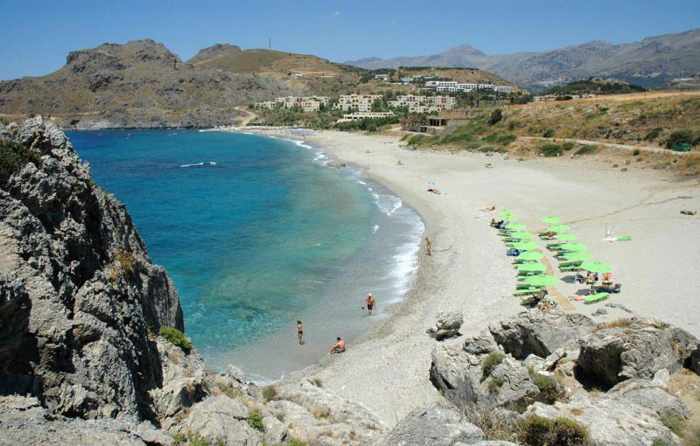
Plakias-Beach on Crete

The water sports enthusiasts can visit the beach in the village of Plakias, situated 40 kilometers from Rethymno, and also Bali, on the national road Rethymno – Heraklion, which is very popular. The beach in Platanes village is appropriate for a quick dip, and it is 4 km east of Rethymno. The beach of Panormo village, 16 km away, is very organized and offer many facilities to the tourists.

Of course, these are the main highlights of Rethymno, however, when you visit it, you will realize that this place offers numerable places with such beauty and long history, that will make you love this city forever.


This article originally appeared on the Cretico Blog published by the Cretico Crete holiday villa website, and is republished with their kind permission.


Why you should visit Paros

Share

BEST OF PAROS from Art in Design-Alternative on Vimeo.


PAROS from Dimitris Christopoulos on Vimeo.


I never need an excuse to visit Greece, but in online travel forums I often see people asking whether they should go to certain places, or wondering why specific Greek destinations are popular.  They think they want to visit them, but they really don’t have a clue what they will get to see and do once they get there.

Paros is one of those places. Since it’s a stop on the busy ferry route between Mykonos and Santorini, the two most popular Cyclades islands, many travellers realize it would conveniently fit into an island-hopping itinerary. But is it the right island for them to visit? Does it have enough attractions to make it a worthwhile stopover for a few days?

I think these two films, which I found on Vimeo today, will help visitors determine if Paros is their kind of place. (I think the answer will most likely be “yes.”) I’ve already been to Paros (twice), but both videos made me want to go back again.

In case you need more convincing, click here to view my Paros Greece 2012 collection on Flickr, which features hundreds of photos from the picturesque harbour village of Naoussa, and several beaches in its surrounding area. Some photos of the main port town of Parikia, as well as the Yria Hotel and the scenic coastline near Parasporos beach, can be viewed in my Paros collection.

How a cultural renaissance is reshaping Athens

Share

Church of Panagia Kapnikarea

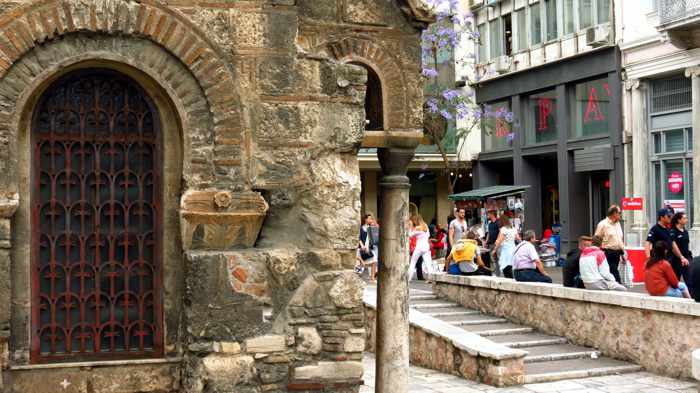
Throngs of shoppers and tourists on Ermou Street pass by the 1,000-year-old Byzantine Church of Panagia Kapnikarea


Gritty, not pretty: After six years of agonizing economic hardship, the City of Athens and its residents appear to be “rebounding” and turning their attention “to the task of building a better future,” according to the Canadian national newspaper, The Globe and Mail.

“More and more Athenians are involved in a kind of civic infill activity, re-imagining the town, improvising social services and engaging in what Greek photographer Eirini Vourloumis calls ‘a forced renegotiation of Greek identity,’” columnist Robert Everett-Green observes in a feature article published recently in the Globe.

“Now, ambitious plans are afoot to remodel the downtown in more sustainable ways, and to add cultural capital to civic life. Innovative restorations, led by artists and arts organizations, are reclaiming rundown industrial districts. There is a feeling here that creativity is the last and best resource when other resources fail,” he notes.


Athens graffiti

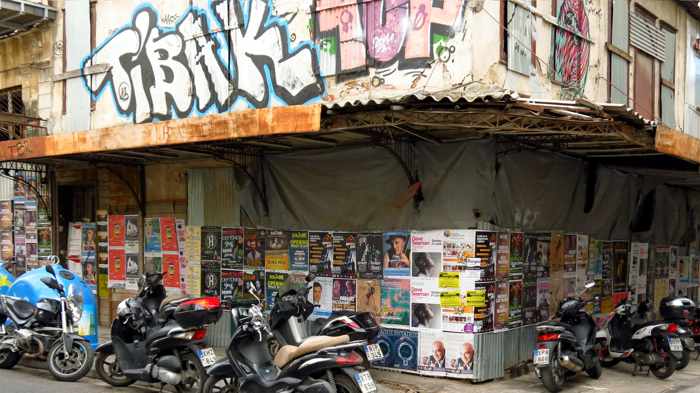
Athens is “gritty,” not pretty, with “rampant” graffiti and street art, but arts and culture are leading the city to a “rebirth” as it recovers from the harsh economic crisis of the past six years, The Globe and Mail newspaper observes.


Everett-Green visited Athens last November, and the Globe published his feature story The Energy of Defeat on the front page of its weekend travel section this past Saturday (March 28 2015).

The article also was published on the newspaper’s website, where it was retitled Athens isn’t pretty, but it’s exciting: discover the city’s cultural rebirth.

Everett-Green examines how artists are playing a leading role in the revitalization of a city he describes as “gritty, restless and spontaneous.” He looks at major cultural projects and initiatives, including:

♦ the new Stavros Niarchos Foundation Cultural Center that will house the Greek National Opera and the National Library of Greece;

♦ the Onassis Foundation’s Rethink Athens project, which will transform the city center along Panepistimiou Street with ambitious public realm improvements and beautification;

♦ the Technopolis cultural event hub in the former premises of a coal and gas plant;

♦  the revitalization of the once-industrial Metaxourgio district; and

♦ the National Museum of Contemporary Art, which has opened in a restored brewery building.

Click here to read the full story on the Globe and Mail website.


Click on the arrow to view this 13-minute virtual tour of the Stavros Niarchos Foundation Cultural Center being built in the Kallithea district of Athens, about 4 km from the city center.


Stavros Niarchos Foundation Cultural Center

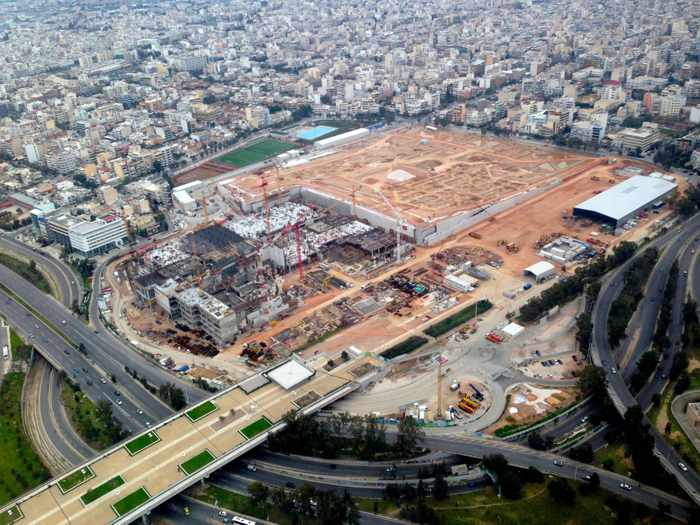
This photo shows an aerial view of construction work on the massive Kallithea site where the Stavros Niarchos Foundation Cultural Center (SNFCC) is being built. Designed by renowned architect Renzo Piano, the center will include a new building for the Greek National Opera, a new National Library of Greece, and an extensive landscaped park. This photo is from the SNFCC project page on the Renzo Piano Building Workshop website,.

The postcard conundrum

Share

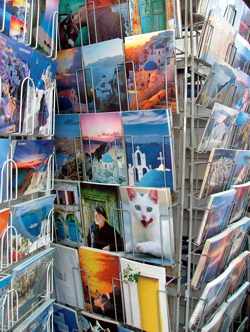
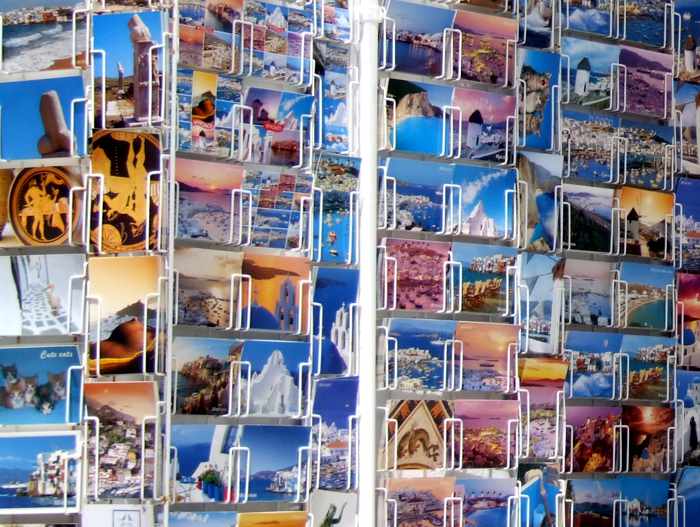
postcard racks on Santorini

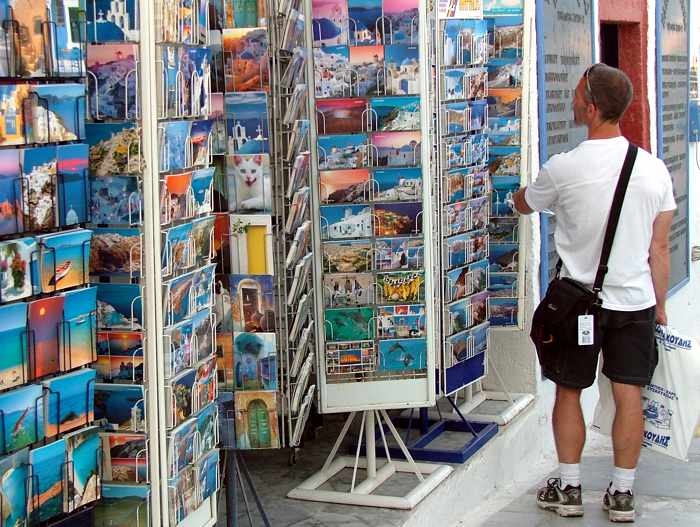
Browsing postcard racks at a souvenir shop in Oia village on Santorini


Travel tradition: Call me old-fashioned, but I still send postcards to family and friends when we’re vacationing in Greece. I’m talking paper postcards with handwritten messages, stamped and posted at letter collection boxes in Athens or villages on whatever island we happen to visit.  The real deal that recipients can actually hold in their hands, not a fleeting e-card or email greeting that will momentarily flash on their smartphones or computer screens!

For me, sending postcards is a fun part of our Greece travel experience — especially since I write the messages and address the cards while enjoying a glass of wine on our hotel room balcony or at a taverna with a wonderful view.

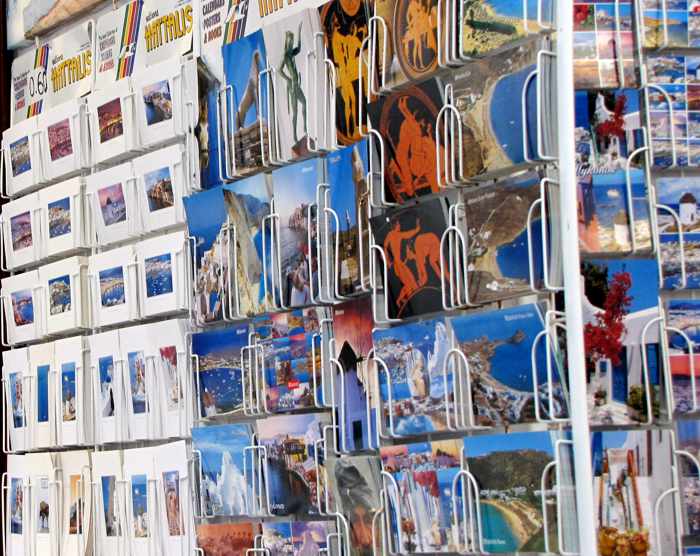
postcards pay here sign But picking the right card for each particular person on my list can be a bit daunting since the array of postcard choices is so extensive. At some souvenir stands in Athens and on a few of the islands we have visited, the selection has been simply staggering — rack after rack after rack, all packed with dozens if not even hundreds of appealing postcards.

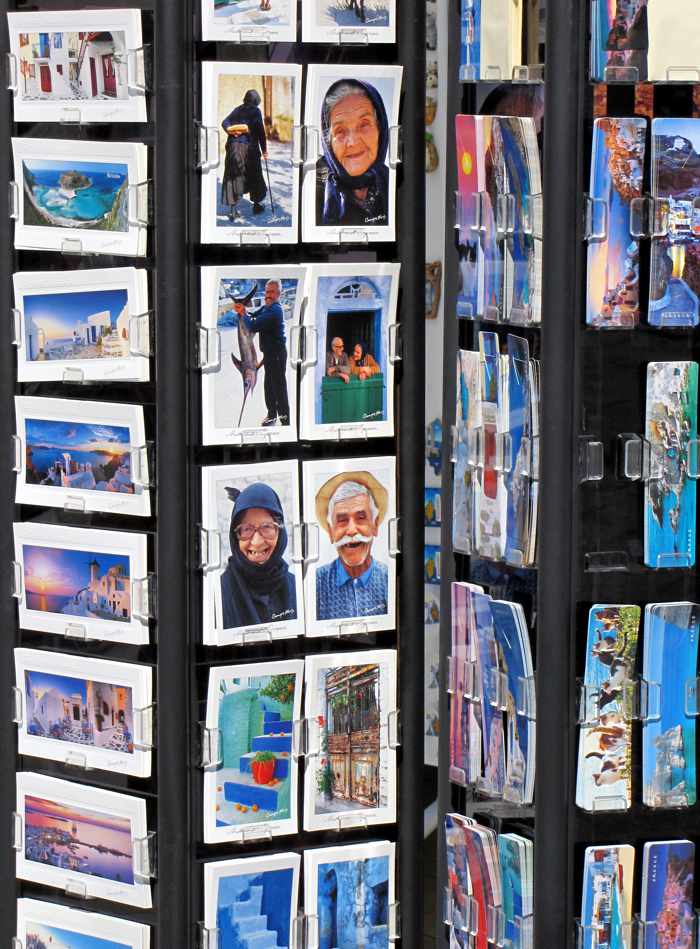
What to choose? Scenes of beaches, mountains, landscapes, churches or villages? Images of monuments, ruins, antiquities or museum artefacts? Photos of cute cats, dogs or donkeys? Pictures of old folks in traditional garb or physically well-endowed young adults clad in skimpy bikinis or Speedos … or wearing nothing at all? (There’s usually even a few “naughty” cards with pictures of ancient pottery bearing images of two or more adults engaged in explicit sex acts.) I usually wind up purchasing more cards than I need, and bring the leftovers home as personal souvenirs.

Santorini postcardsWhat I particularly like about postcard shopping in Greece is the careful way most of the souvenir shop staff handle the cards I’ve decided to buy. They always insert the cards (and any stamps I purchase) inside either a small paper bag or a clear plastic sleeve, so the cards won’t get scuffed or bent before I have a chance to write and post them. It’s touching how some of the shopkeepers appear so grateful and proud that a visitor will be sending postcard pictures of Greece to people around the world.

The only downside to picking postcards is that I inevitably find pictures of spectacular places that I didn’t know about, or didn’t have time to see. But that just means there will always be new sites and attractions to explore on a return visit.

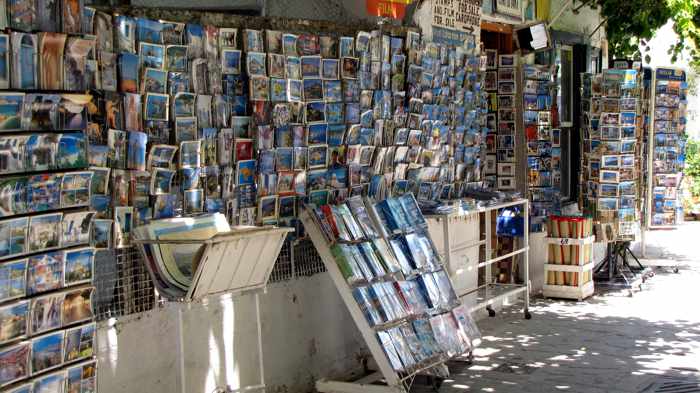
Kokkari postcard shop

This postcard shop in Kokkari village on Samos had the best selection I’ve seen anywhere. Besides the cards displayed outside, the shop had hundreds more to choose from inside!


Kokkari postcard shop

Some of the cards displayed outside the Kokkari souvenir shop.


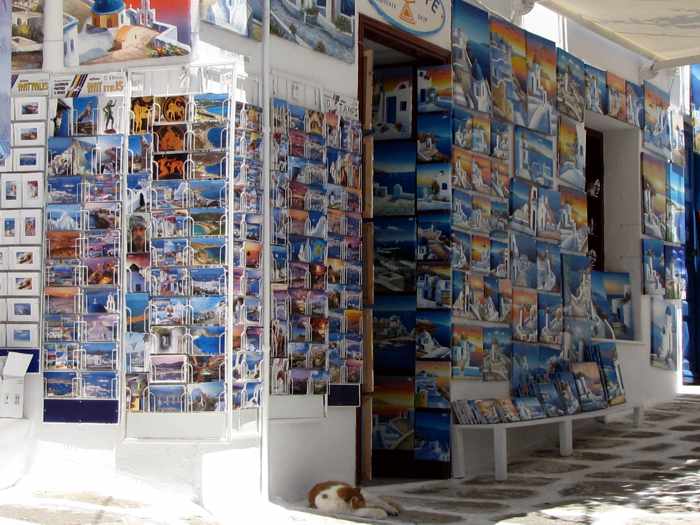
Archetype souvenir shop Mykonos

A cat snoozes beneath a postcard display at the Archetype souvenir shop near the Paraportiani church in Mykonos Town

 Archetype Souvenir Shop

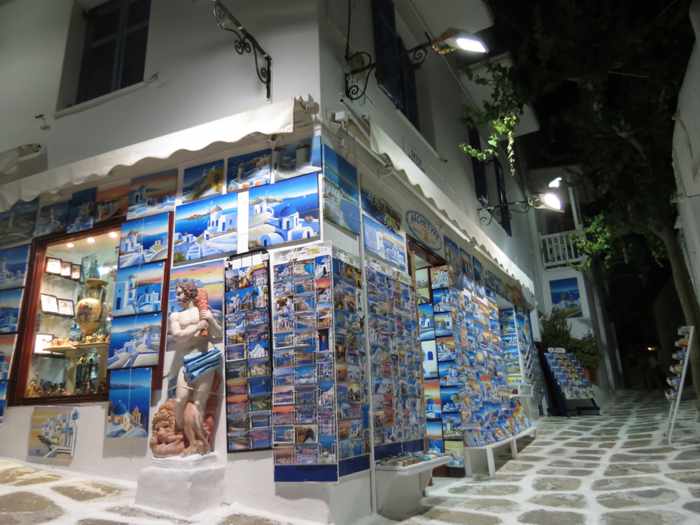
Night view of the Archetype souvenir shop in Mykonos Town


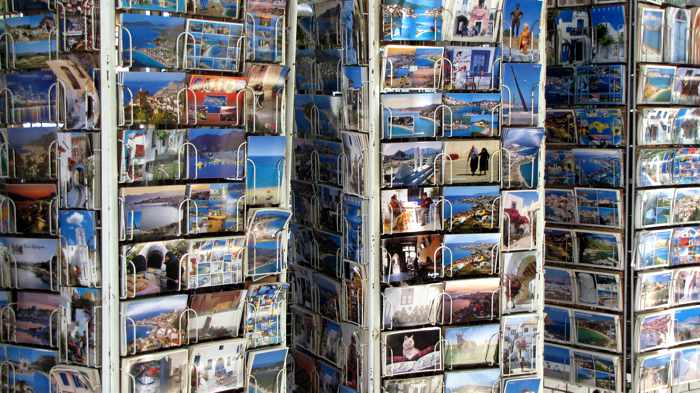
postcard racks in Mykonos Town

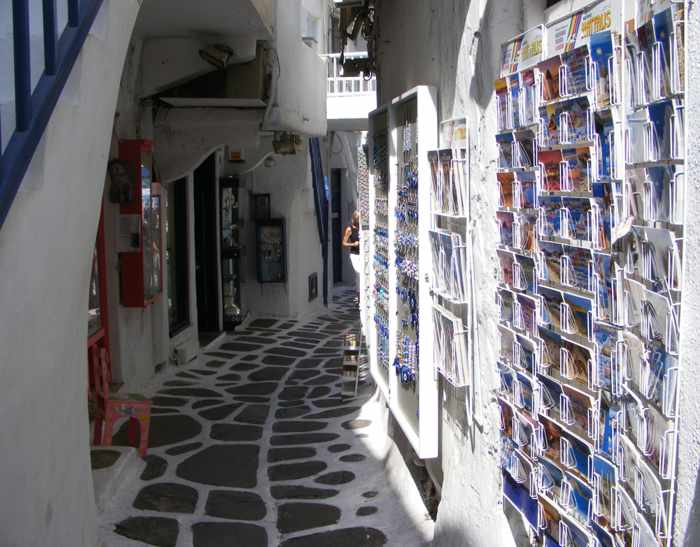
Postcard racks in a narrow lane in Mykonos Town

  Naxos postcards

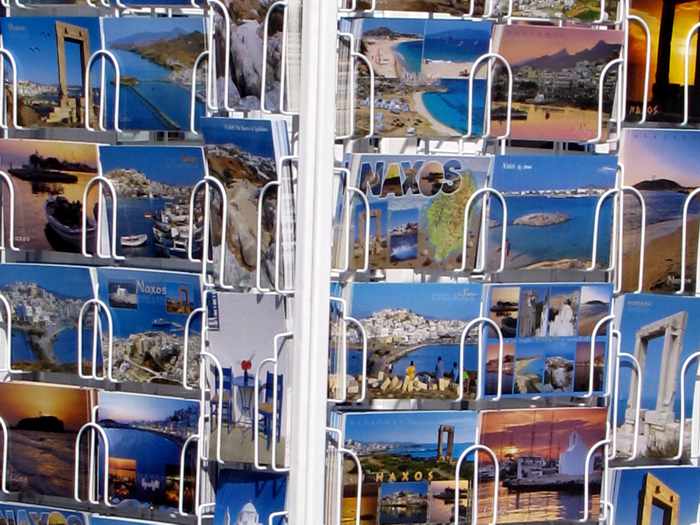
Postcard display outside a shop on the Naxos Town waterfront


postcards in Oia

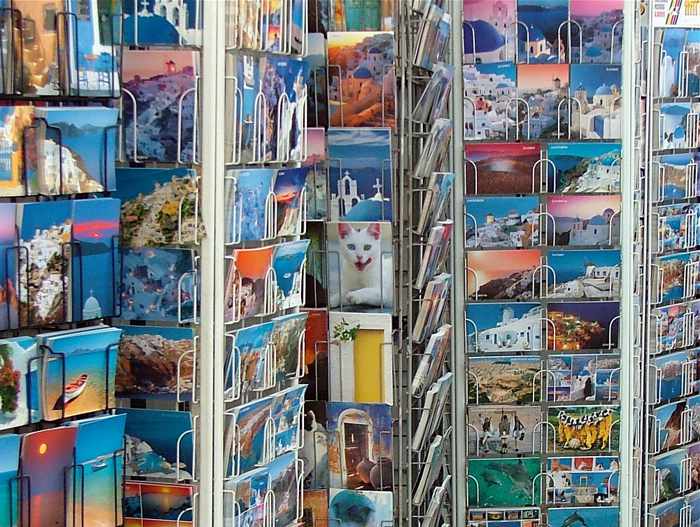
Postcard racks outside a souvenir shop in Oia village on Santorini


Mykonos postcards

Postcards on display in Mykonos Town


Mykonos postcards

Postcards at a Mykonos souvenir stand


Naxos postcards

A postcard and bookmark display at a shop in Naxos Town

The history behind Santorini’s spectacular caldera cliffs

Share

Click on the arrow to view Santorini volcano history, a fascinating 6-minute video by Santorini resident Nikos Korakakis


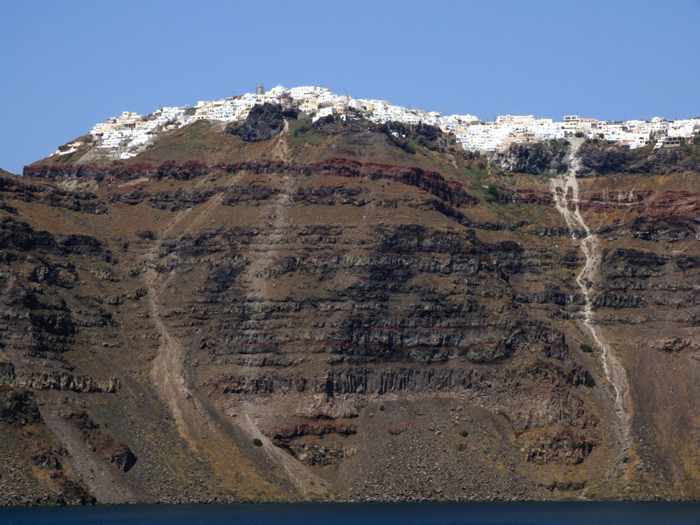
Captivating cliffs: Like most people who have visited Santorini, I know that the island’s distinctive crescent shape was created by hundreds of thousands of years of volcanic activity. I’ve read about it in travel guides, and I have seen illustrations of the island’s various different shapes over the centuries in some of the souvenir books I’ve collected on our travels.

But a video that I recently discovered does the best job, in my opinion, of showing precisely how the volcanoes and the course of time have shaped the Santorini of today.

Produced by Nikos Korakakis, an art director who lives and works in Santorini, the nearly 6-minute-long film is based on research by scientists, institutes and universities. It features narration (in Greek) by Anastasia Platanioti and music by Ross Bugden.

Although the narration is completely in Greek, you don’t have to understand the language to follow the video — the film includes explanatory English text superimposed on the animated illustrations.

Click the arrow at the bottom left corner of the video screen (top) to watch how centuries of volcanic activity created the spectacular island scenery that will enthrall more than a million visitors from around the world this year.

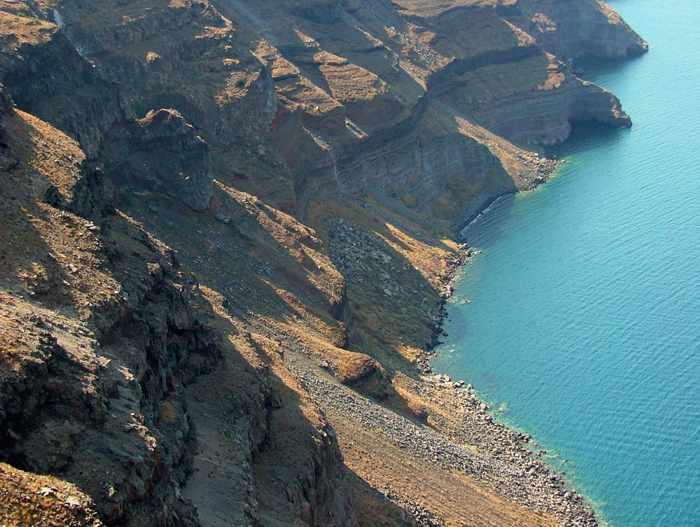
Below are just a few of the photos we have shot of the magnificent caldera cliffs that have taken our breath away on three visits to Santorini. You can full-size versions of those images, along with dozens of additional photos, in The Cliffs, an album on the MyGreeceTravelBlog Flickr page.


Imerovigli village

The homes and hotels in Imerovigli village are precariously perched atop cliffs that climb hundreds of meters above the sea


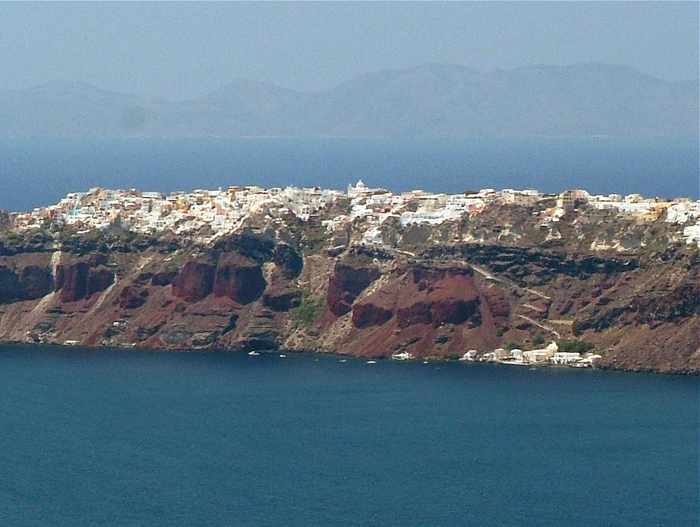
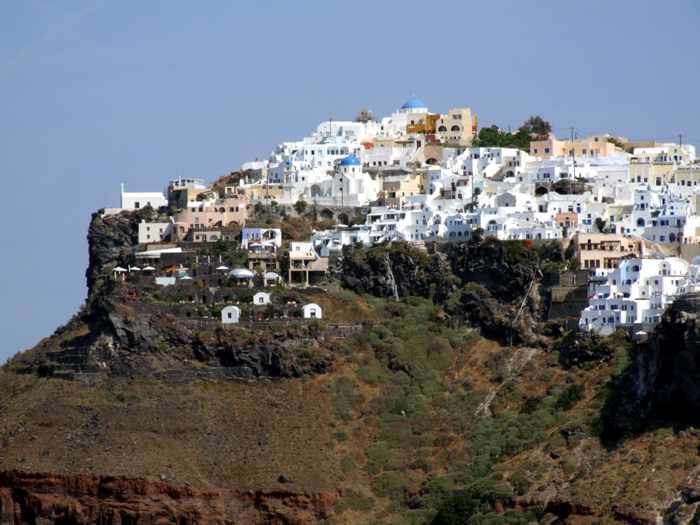
Oia village

Oia village at the northern tip of Santorini is seen in this distance photo shot from Skaros Rock at Imerovigli


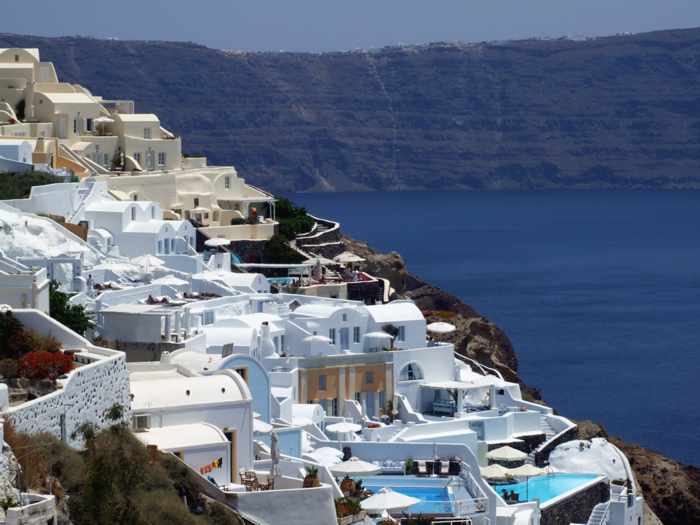
Oia Santorini

Resorts cling to the steep upper slopes of the caldera cliffs at Oia


Santorini caldera cliffs

A view toward Imerovigli (center) and Skaros Rock (to the left of Imerovigli) from the Athinios ferry port on Santorini


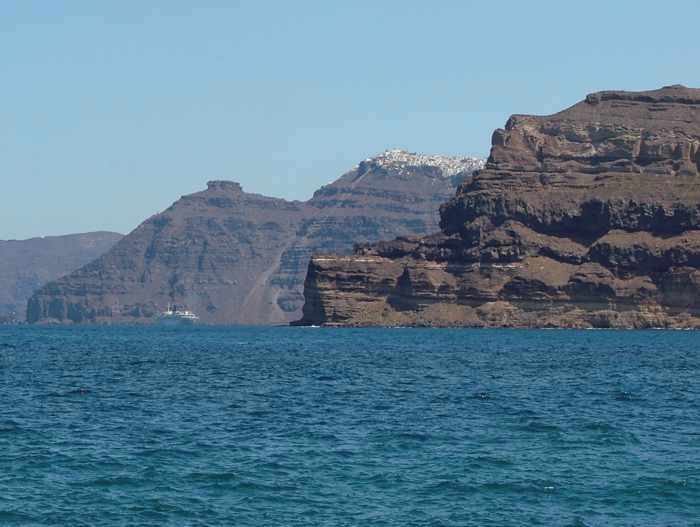
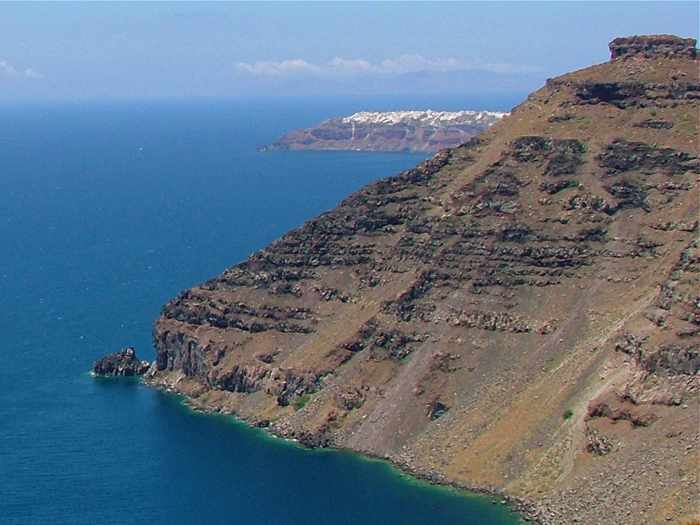
Skaros Rock and Oia

A view of Skaros Rock and, in the distance, Oia village


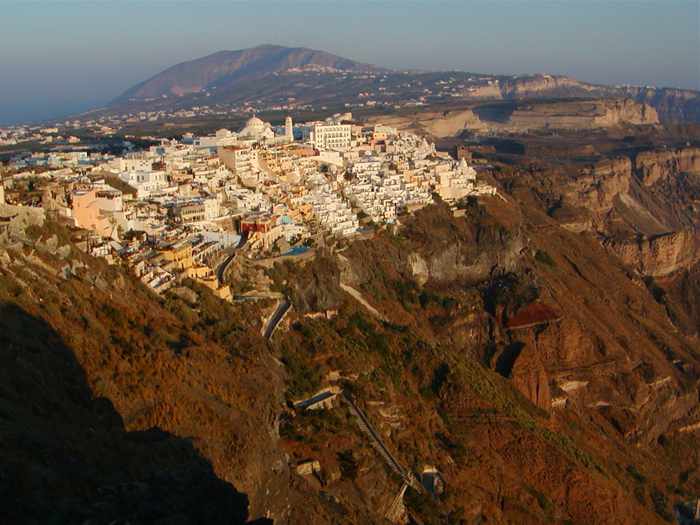
Fira Santorini

Fira is the biggest town and the main commercial center on Santorini


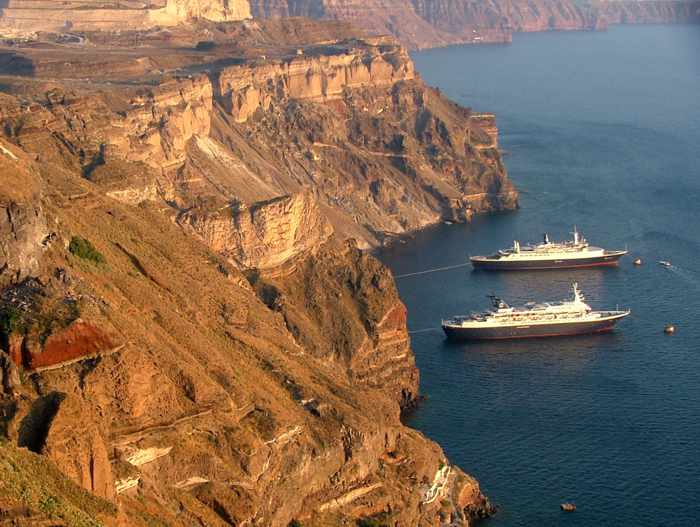
cruise ships at Fira

Cruise ships anchored near the caldera cliffs below Fira


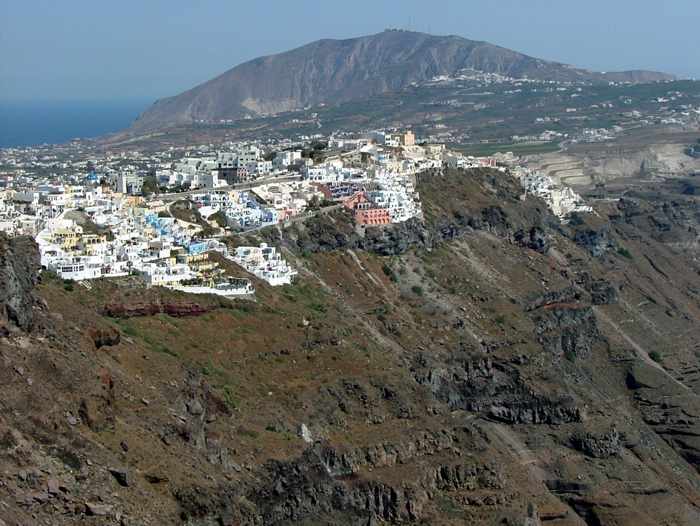
Firostefani village

The village of Firostefani is a short but very scenic walk from Fira


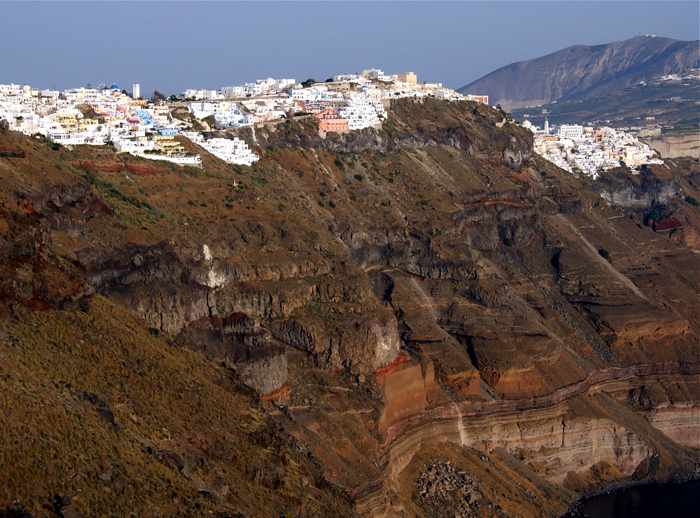
Firostefani village

The caldera cliffs below Firostefani


Santorini caldera cliffs

The rugged cliffs plunge hundreds of feet to the turquoise sea in the caldera


Imerovigli village

We shot this photo of Imerovigli from a terrace at our hotel in Firostefani


Armeni Village resort at Oia

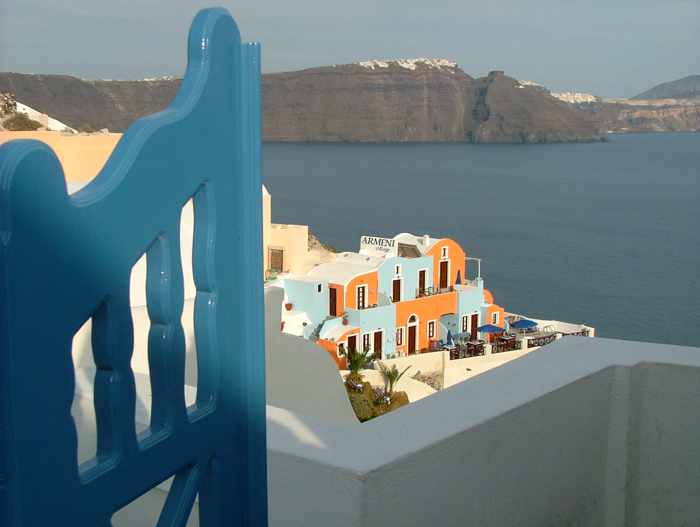
A view of the Armeni Villas resort in Oia, with Imerovigli and Skaros Rock providing a backdrop across the caldera


Oia village on Santorini

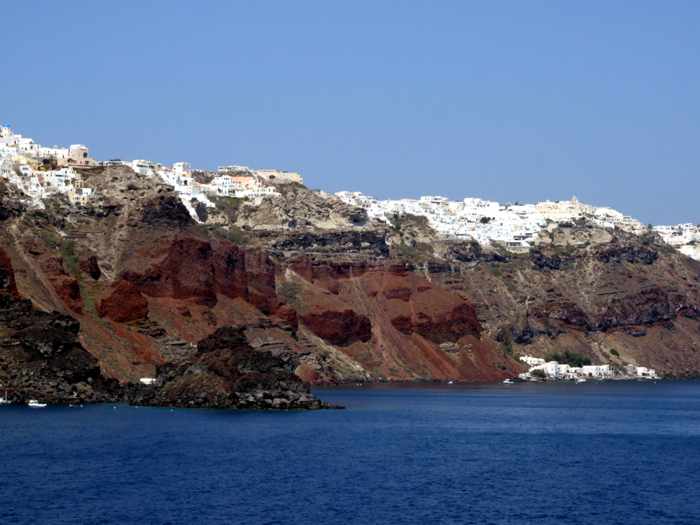
Oia, seen from the top deck of a Blue Star ferry as we arrived at Santorini


Santorini caldera cliffs

We captured this view of the caldera cliffs during a walk from Fira to Oia along the island’s world-famous clifftop footpath


 Click here to view 125 photos of the caldera cliffs on the MyGreeceTravelBlog Flickr page.

Only on Mykonos! A bizarre ‘table dancing’ performance from a 1960s travel film

Share

 This excerpt from a travel promotion shows scenes from Mykonos Town from sometime in the early 1960s


I love seeing old photos and films from Athens and the various Greek Islands we have visited so far — especially if they show places like Mykonos before traditional island life gave way to the glitz and glamour of high-end hotels, shops and restaurants aimed at affluent international tourists.

So it was fun to find this black and white tourism promotion film with scenes of Mykonos Town in the early 1960s before it was drastically transformed by extensive tourism-related development.

But besides views of the town’s iconic cube-shaped white buildings, its maze of cobblestone streets, and the island’s famous pelican mascot, Petros, the film includes an odd table dancing demonstration performed for the entertainment of tourists at a taverna.

Footage of what the film narrator describes as “a very strange performance” starts around the 2:10 mark of the video.

It shows “a very special talent by an enterprising young man,” the narrator says.

You’ll have to see it for yourself to believe it. It’s nothing like the Zorba the Greek dance that tourists might get to see while visiting Greece nowadays!


« Older posts Newer posts »

© 2026

Theme by Anders NorenUp ↑