
Category: Greek Islands photos (Page 35 of 70)

Don’t ride the donkeys! Why tourists should avoid taking the mule ‘taxis’ on Santorini

Share

 Fira on Santorini

Cruise ships that visit Santorini drop anchor in the sea below the capital town of Fira and tender passengers to shore. From there, visitors reach Fira either by walking approximately 600 steps up the path (left) that zig-zags up the face of the 800-foot cliff  …


Santorini cable car

… by paying several Euros for the 3-minute ride up the cable car lift


donkey in Santorini

… or by riding a donkey like this one, which we encountered in Firostefani village during one of our three visits to Santorini. The donkey rides, which cost around €5, are a transport option that local mule owners provided for years before the cable car was installed. But animal welfare groups and even some cruise lines strongly urge travellers not to take the donkey “taxis” because the animals toil in poor working conditions and have been subjected to abuse and mistreatment by their handlers.


Ass transit:   Now that it’s spring, tens of thousands of people around the world are finalizing their plans for holidays in Greece this summer. Many will be travelling on cruise ships that will visit several Greek Islands, including what is probably the most popular port stop of all — Santorini.  Hundreds of those people may be hoping to make their arrival at Santorini even more memorable and “romantic” by taking what they believe will be a “traditional” donkey ride up the long path that links the cruise ship dock with the town of Fira, the island’s capital, which is perched atop the caldera cliffs hundreds of feet above the sea. Here’s a simple word of advice if you’re thinking about doing the same thing: don’t.

Though the donkeys might look “cute,” and the rides might appear to be a harmless and fun tourist attraction, travellers who use the mules as transportation actually contribute to animal abuse, according to animal welfare organizations and frequent visitors to the island who have personally witnessed handlers mistreating their donkeys.


[adToAppearHere]


The abuse takes several forms. The roughly 360 donkeys and mules that work as tourist “taxis” on the island are forced to climb up and back down a pathway with around 600 steep steps, making as many as seven trips a day between 9 o’clock in the morning and sunset. Often, the animals are required to carry tourists who, putting it bluntly, are obese and may weigh considerably more than the donkeys themselves.  And the mules must do this exhausting, gruelling work in blazing sunshine and searing summer heat, often with unsatisfactory food, water and rest periods, plus few if any breaks in the shade. To add insult to injury, they may be wearing ill-fitting harnesses that inflict cuts and sores on their bodies, while their owners or handlers may frequently strike them with sticks to make them move or hurry up. In short, they toil under cruel and deplorable working conditions.

CONTINUED ON PAGE 2

Mule tidings: donkey tales from the islands

Share

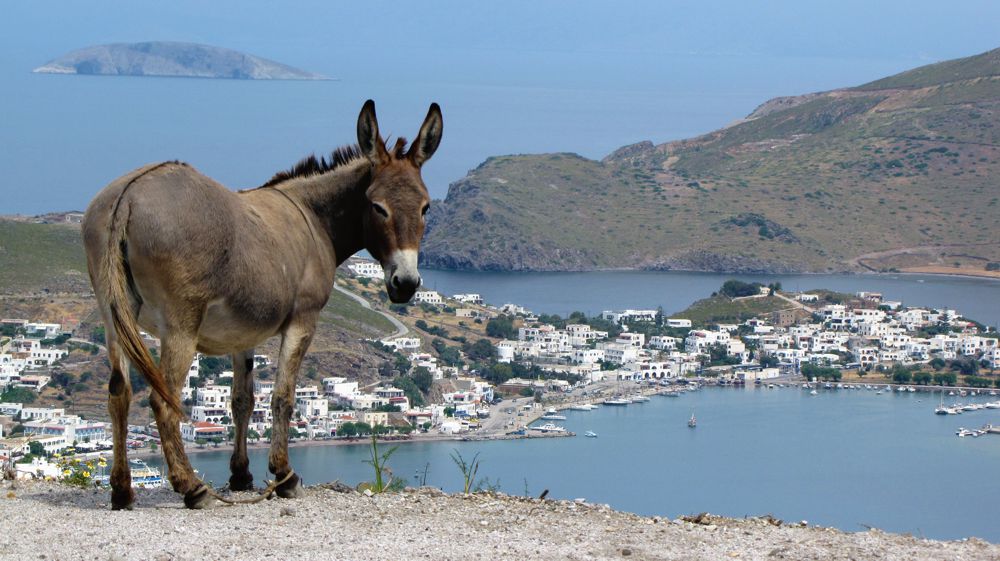
a donkey on a hillside overlooking the Skala, the port town on Patmos

This donkey enjoys a spectacular view of Skala, the port town on Patmos, from his hilltop vantage point on the edge of Chora


Donkey tales: Mules and donkeys can be a common sight on many of the Greek Islands including — not surprisingly — two of the country’s most popular tourist destinations: Santorini and Rhodes. If you visit Santorini’s capital town Fira, especially during a cruise, you’ll see scores of the animals working as taxis to transport tourists up and down hundreds of steps linking the small port to the town 220 meters above sea level (see my Don’t ride the donkeys! post above for more about that controversial practice). On Rhodes, dozens of donkeys are similarly pressed into service to lug lazy sightseers up the path to the Acropolis above Lindos.

On smaller isles that don’t draw huge hordes of tourists and cruise ship visitors, you’re more likely to see donkeys grazing in fields and yards while you hike or drive around. Sometimes you might not be able to see them, but you’ll clearly hear them — their boisterous braying can carry across a long distance. And at other times, you can wind up having a close encounter with one or more of the animals just when you least expect it.

CONTINUED ON PAGE 2

A Santorini church on the streets of Toronto

Share

Oia church

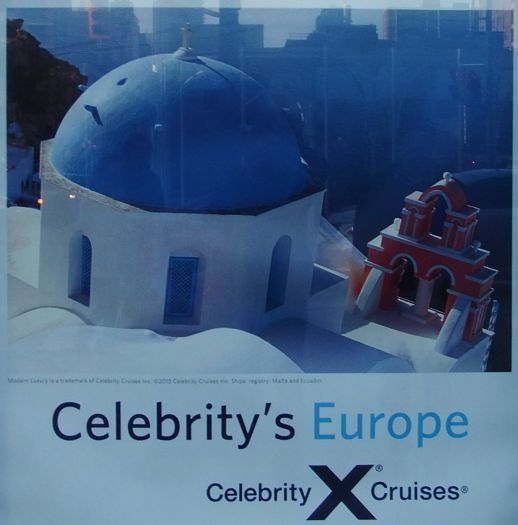
This pillar advertisement for Celebrity Cruises, near the intersection of Yonge & Bloor Streets in Toronto, features one of the most frequently photographed churches on Santorini


Celebrity Cruises ad

There are hundreds of blue domed churches in Greece, but this one in the village of Oia stands out from the rest thanks to its distinctive coral-coloured belltower 


Picture perfect church: I think about Greece every day, but a cruise ship advertising campaign in downtown Toronto recently steered my thoughts to Santorini and the three times we’ve been to that particular island.

The “Celebrity’s Europe” poster ads for Celebrity Cruises featured one of the most photographed icons on Santorini — a blue-domed church with a coral-coloured belltower in the incredibly picturesque village of Oia, high above the wine-dark sea. The ads appeared on sidewalk pillars in different parts of downtown Toronto, and caught my attention whenever I went for a walk. The picture of the Oia church made me feel a tad wistful about our previous visits to Santorini, but also got me more excited to plan our next trip to Greece. (No, it won’t be a cruise — and we won’t be going back to Santorini.)

CONTINUED ON PAGE 2

« Older posts Newer posts »

© 2025

Theme by Anders NorenUp ↑