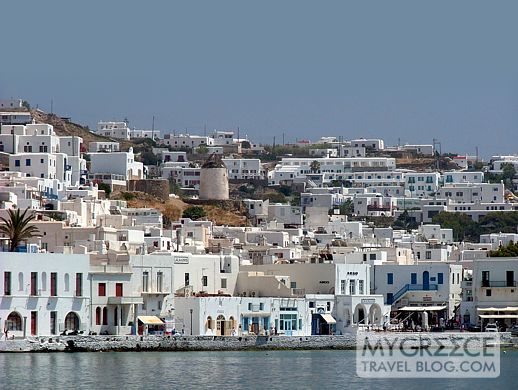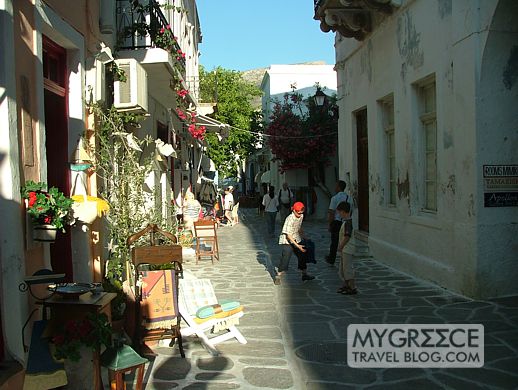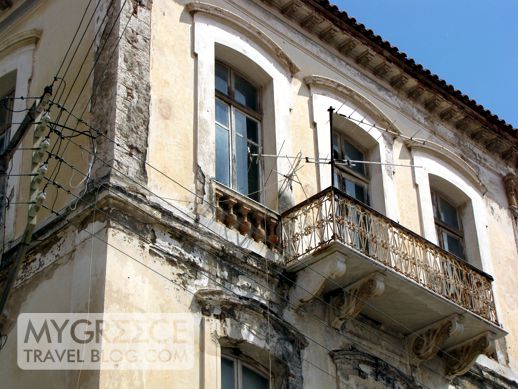
A house in the town of Vathi on Samos

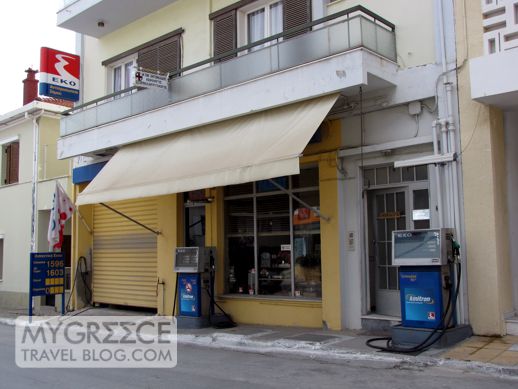
This Eko gas station occupies the ground level of a building on a commercial and residential street in the town of Vathi, on Samos. The fuel pumps sit on the edge of the road, smack up against the front of the building.
Sidewalk station: While we were walking around the main town of Vathi shortly after arriving on Samos in May 2010, we were surprised to see a pair of fuel pumps standing beside a building midway up a residential and commercial street, just a short stroll from the waterfront. Only a few feet away sat a sign advertising prices for unleaded (€1.596) and “super” (€1.603), while a “no smoking” decal was pasted to the windows between the two pumps. At first we thought the pumps might be just an attention-getting part of a modern art installation outside a contemporary gallery, but then we noticed the Eko sign sticking out from a corner on the building’s second floor. It really was a gas station.
I can’t recall ever seeing a service station with fuel pumps positioned literally on the edge of a road, let alone mere inches from the side of a building. And I had never seen one operating from the ground level of a building in the middle of a street full of shops and apartments, either. I’m fairly certain that, in North America, putting gas pumps so close to a building or a roadway would probably contravene fire codes, safety laws and myriad other regulations.
The station was closed, so we didn’t get to watch anybody stop for a fill-up. But imagine the convenience of not having to pull your car off the road and into a service station to get gas!
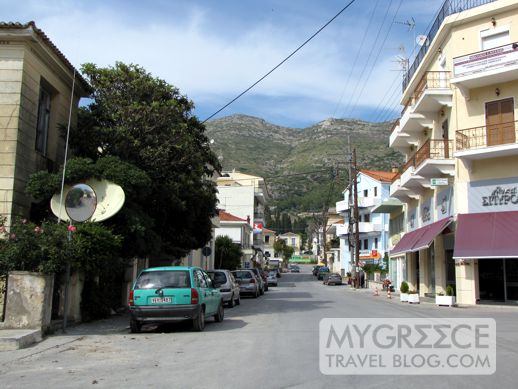
The red, white and blue sign for the Eko gas station is visible above the cars parked halfway up the block on the left side of the street
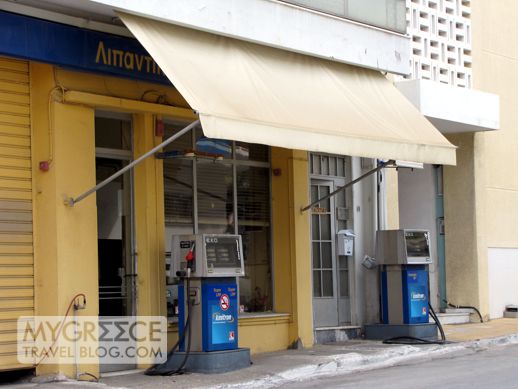
Another view of the Eko station, from a different angle
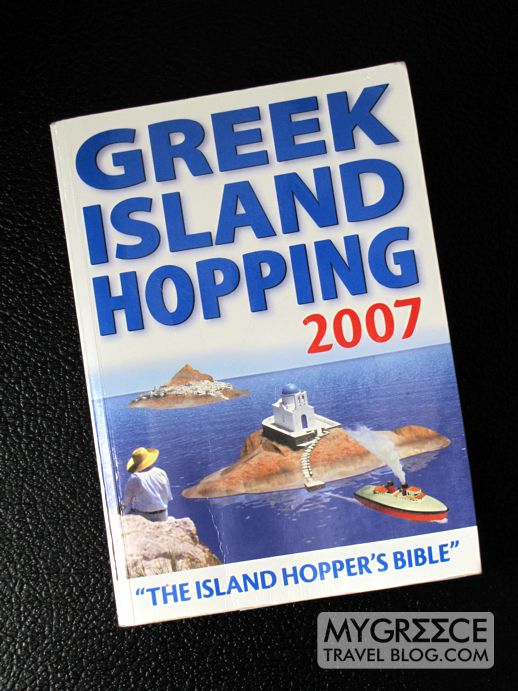
The cover of my 2007 Greek Island Hopping guide by Thomas Cook Publishing
Great guidebook: It’s already five years old, but much of the information in my well-worn copy of Greek Island Hopping 2007 is still so relevant and useful, this is the first book I pick up whenever I need to plan a trip or find an answer for questions that friends or I might have about travelling in Greece.
Known as the Bible of Greece travel guidebooks, the Greek Island Hopping series is written and researched by Frewin Poffley, who packs an incredible amount of detailed and helpful information — along with maps, illustrations and photos – between the covers of each year’s thick paperback edition. (There are 720 fact-filled pages in my 2007 version.)
The book’s primary focus is on ferry travel, explaining how to go from one destination to another using Greece’s complicated and often confusing interisland ferry network. But it also offers a wealth of information about things to see and do on each island, as well as in Athens and all of the ports on the Greek mainland. The book also provides advice about accommodations, but that content seems to be aimed chiefly at backpackers and budget travellers seeking wallet-friendly hotel options, as well as hostels and campsites. (It won’t give much guidance if you’re trying to decide between two 5-star caldera view hotels in Oia, on Santorini, but if you’re going to be paying €500+ per night for somewhere to sleep, you’ve probably got a travel agent making those arrangements for you anyways.)
I find the guidebook particularly useful for its maps of port towns, key island villages, and important tourist attractions, such as the archaeological ruins on Delos island and The Asklepieion on Kos, to name just two. And while there’s a staggering amount of dry — but important — factual data in the guidebook, Poffley’s candid, personal descriptions of each destination make for an amusing and fun read. (I don’t always share the same impressions about some of the islands, but I can see where Poffley’s coming from with many of his sharp-witted observations.)
Greek Island Hopping 2012 hits bookstores later this month, and can be ordered online. Don’t go island hopping without one!
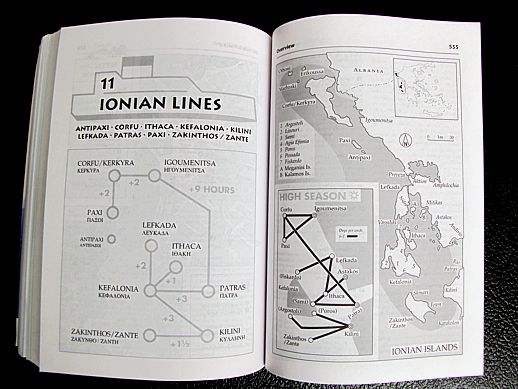
The Greek Island Hopping books provide incredibly detailed information about the Greek ferry network, including routes, ferry lines, and individual boats.
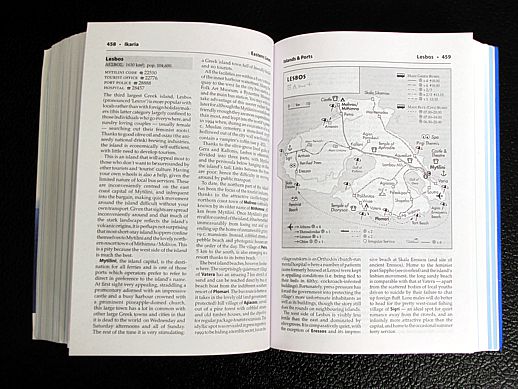
The book features information about each island and its ports, with maps, photos and illustrations showing how to get around and where to find key attractions
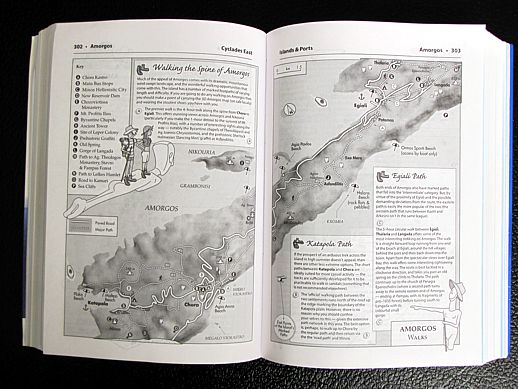
Not only does the book tell you how to ferry from one island to another, it even shows how to get from one village to another once you’re there. This 2-page map, for instance, shows hiking paths that run the length of Amorgos.
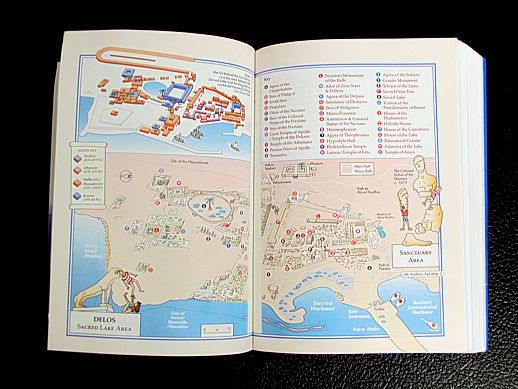
The book’s colour map and detailed descriptions of Delos Island will help you enjoy the historic archaeological ruins completely at your own pace, instead of in a huge tour group or with an expensive private guide
Theme by Anders Noren — Up ↑